When Google shows your business in search results, it is guessing at what your website means. Your homepage says you are a plumber in Cork, but to a search engine that is just text on a page. Local business schema markup removes the guesswork: it is a small block of code that tells Google, in a language it fully understands, exactly what your business is, where it is, what it does and when it is open.
This guide explains schema markup for Irish local businesses in plain English: which types you actually need, what LocalBusiness, Service and FAQ markup really do, the mistakes that can get your markup ignored, and how to check that yours is working.
What Schema Markup Actually Does (and Does Not Do)
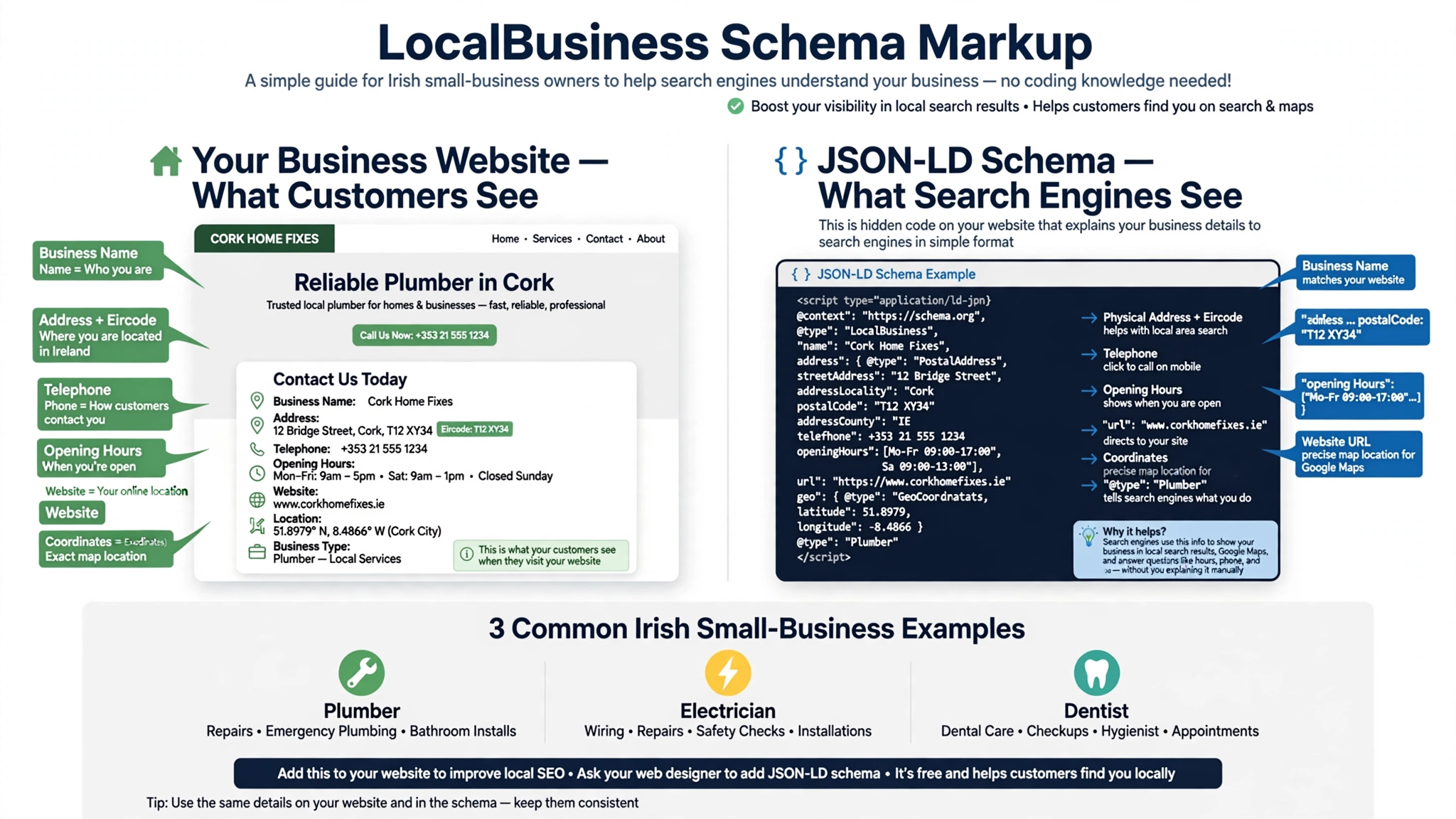
Think of your website as a shop window and schema markup as the labels on everything in it. Visitors can see what things are without labels, but labels make it instant and unambiguous — especially for someone who cannot see the display clearly. Search engines are that someone.
Technically, schema markup is structured data: code, usually written in a format called JSON-LD, added to your pages that describes the content in a standardised vocabulary maintained at Schema.org. Google documents which types it supports and how it may use them.
Here is what it can do for a local business:
- Help Google understand your business as an entity — your name, address, phone number, opening hours, services and service area become confirmed facts rather than text Google has to interpret.
- Make you eligible for rich results — enhanced search listings such as review stars, FAQs or breadcrumbs. Eligibility is not a guarantee: Google decides algorithmically whether to show a rich result.
- Support AI search citations — clear, structured entity data helps answer engines such as ChatGPT, Perplexity and Google AI Overviews resolve exactly who you are and cite you confidently. This is part of what AEO and GEO services build on.
And here is what it does not do:
- It does not guarantee higher rankings. Google has never said schema markup is a direct ranking factor. It helps understanding and eligibility for enhanced displays, which is valuable — but it is not a shortcut past relevance, reviews and links.
- It does not fix a thin website. Markup describes content that must already exist on the page and must match it. Marking up services you do not describe, or reviews you do not show, will get the markup ignored.
Which Schema Types Irish Local Businesses Actually Need
There are hundreds of schema types. Most Irish small businesses need only a handful:
| Schema type | What it describes | Priority |
|---|---|---|
| LocalBusiness (or a subtype) | Your business identity: name, address, phone, hours, location | Essential |
| Organization | Your brand as an organisation, logo and official profiles | Recommended |
| Service | Individual services you offer | Recommended |
| BreadcrumbList | Your page’s position in the site structure | Recommended |
| FAQPage | Questions and answers on the page | Optional — see the 2026 note below |
| Review / AggregateRating | Reviews of your business | Use with great care — strict rules apply |
Everything else — events, job postings, recipes, videos — only matters if your business genuinely publishes that kind of content.
LocalBusiness Schema Explained
Google’s LocalBusiness structured data documentation describes this as the markup for your business details. It is the single most important schema type for a local business website.
Use the most specific subtype
LocalBusiness has many subtypes. Using the most specific one helps Google classify you correctly. Common examples for Irish businesses include:
- Plumber — for plumbing businesses
- Electrician — for electrical contractors
- Dentist — for dental practices
- Attorney — for solicitors’ firms
- HomeAndConstructionBusiness — for builders and general contractors
- Restaurant, Hotel, HairSalon, AutoRepair — and many more
If no subtype fits precisely, fall back to LocalBusiness itself rather than forcing an inaccurate one.
The properties that matter most
Google requires name and address. Beyond those, the properties that do the most work for an Irish local business are:
- address — your full street address. Include the Eircode in the postalCode field; it is the most precise location identifier in Ireland.
- telephone — the number customers should call, in international format (e.g. +353 1 234 5678).
- url — your website address.
- openingHoursSpecification — your opening hours, including any weekend or seasonal variation.
- geo — your latitude and longitude. This pins your business to an exact map location.
- areaServed — the places you serve, such as “Cork”, “County Cork” or a list of towns. Important for service-area businesses without a shopfront.
- priceRange — a simple indicator such as “€€”.
- sameAs — links to your official profiles (Google Business Profile, Facebook, LinkedIn).
Keep every one of these consistent with what is visible on your website and on your Google Business Profile. Conflicting details across the three undermine the whole point of the markup.
What LocalBusiness markup actually does
It turns your identity into confirmed data. When Google’s systems agree that the plumber at a Cork address with a specific phone number and opening hours is one real entity, that entity can be connected across Search, Maps and AI answers. It does not by itself create a knowledge panel or a Maps listing — those depend on many other signals — but it removes ambiguity that would otherwise hold you back.
Organization vs LocalBusiness: Which One Do You Need?
This confuses many business owners, because the two overlap. The simple version:
- LocalBusiness describes a business with a physical presence or local service area — the shop, practice or trade business customers visit or book.
- Organization describes the brand or company behind it — useful for the logo, official name and corporate contact details. See Google’s Organization documentation.
A typical Irish SME should have LocalBusiness markup on location and service pages and Organization markup on the homepage identifying the brand. They should reference each other rather than contradict each other: same name, same phone number, same URL.
Service Schema: Describing What You Sell
While LocalBusiness says who you are, Service schema says what you do. Each distinct service — boiler servicing, emergency callouts, bathroom renovations — can carry its own Service markup describing the service name, the area it covers and the provider.
This is particularly useful when your services have their own pages. A dedicated “Emergency Plumber Cork” page with matching Service markup gives Google a clean, unambiguous statement of what that page offers and where. As with everything in structured data, the markup must reflect content that is genuinely on the page.
FAQ Schema: An Honest Update for 2026
FAQ markup used to earn expanded question-and-answer listings directly in Google search results, and many older guides still recommend it for that reason. Be aware of what changed:
Google retired FAQ rich results in May 2026. Expanded FAQ listings no longer appear in Google Search for ordinary business websites; the documentation now limits the feature to well-known, authoritative government and health sites, and Search Console reporting for it has been wound down.
What does that mean for your business?
- FAQPage markup is still valid schema.org vocabulary. Leaving existing markup in place causes no harm.
- But there is no longer a Google rich-result payoff for adding new FAQ markup to a typical Irish business site.
- Well-written FAQ content still has value: it answers real customer questions, and clear question-and-answer formatting helps AI answer engines extract and cite your pages.
So keep writing good FAQs for your visitors — just do not invest in FAQ markup expecting expanded listings in Google.
Breadcrumb Schema: Small Markup, Real Clarity
BreadcrumbList markup describes where a page sits in your site’s structure — for example, Home > Services > Boiler Repair Cork. See Google’s breadcrumb documentation.
Its job is modest but genuine: it can help Google display a clean breadcrumb trail instead of a raw URL in search results, which tells searchers where they will land before they click. It takes minutes to implement with an SEO plugin and there is little reason not to have it.
Reviews and Star Ratings: The Strictest Rules in Schema
Star ratings in search results are eye-catching, which is exactly why Google polices them hard. Read Google’s review snippet guidelines before touching this markup, because the key rule catches many businesses out:
You must not mark up reviews of your own business on your own website.
If the reviews about your business appear on your own site — directly in your structured data or through an embedded widget showing your Google or Facebook reviews — your pages are ineligible for the star-rating rich result. Google calls these “self-serving” reviews, and the restriction applies to both LocalBusiness and Organization markup.
Practical consequences for Irish businesses:
- Do not add aggregateRating to your LocalBusiness markup based on your Google reviews. It will not earn stars and it violates the guidelines.
- Do not invent, buy or incentivise reviews. Google’s spam policies treat fake review markup as a violation, not a tactic.
- Do keep earning genuine Google reviews on your Google Business Profile — those stars can appear in your Maps listing and business profile, which is where they carry the most weight anyway.
- Review markup is legitimate when you publish genuine reviews of someone else’s products or services — for example, a detailed review of a supplier’s equipment.
How to Add Schema Markup on WordPress
You have three realistic options, in order of practicality for most small businesses:
1. Let your SEO plugin handle it
If your site runs Rank Math or a similar SEO plugin, LocalBusiness/Organization schema is usually a settings page, not a coding task. Fill in your business name, type, address, phone, opening hours and logo once, and the plugin outputs the JSON-LD on the right pages. This covers most Irish SME needs with the least risk of errors.
2. Add JSON-LD manually
For full control — for example, detailed Service markup on individual service pages — you can add a JSON-LD script block to the page. A minimal LocalBusiness example looks like this:
{
  "@context": "https://schema.org",
  "@type": "Plumber",
  "name": "Example Plumbing Ltd",
  "telephone": "+353 21 234 5678",
  "url": "https://www.example.ie/",
  "address": {
    "@type": "PostalAddress",
    "streetAddress": "12 Example Street",
    "addressLocality": "Cork",
    "postalCode": "T12 AB34",
    "addressCountry": "IE"
  },
  "openingHoursSpecification": {
    "@type": "OpeningHoursSpecification",
    "dayOfWeek": ["Monday","Tuesday","Wednesday","Thursday","Friday"],
    "opens": "08:00",
    "closes": "18:00"
  },
  "areaServed": "County Cork"
}
Replace every value with your own real details. Never copy an example verbatim and leave placeholder data on a live page.
3. Hire it done as part of technical SEO
If your site has multiple locations, many services or conflicting markup from several plugins, getting it set up cleanly in one pass is usually cheaper than debugging it later. This is standard work inside a managed SEO service.
One warning that applies to all three options: do not run two systems generating the same markup. A plugin plus a theme plus manual code can output three competing LocalBusiness blocks, and contradictory structured data helps nobody. Pick one source of truth per schema type.
How to Check Your Schema Is Working
Adding markup is only half the job. Verify it with Google’s own tools:
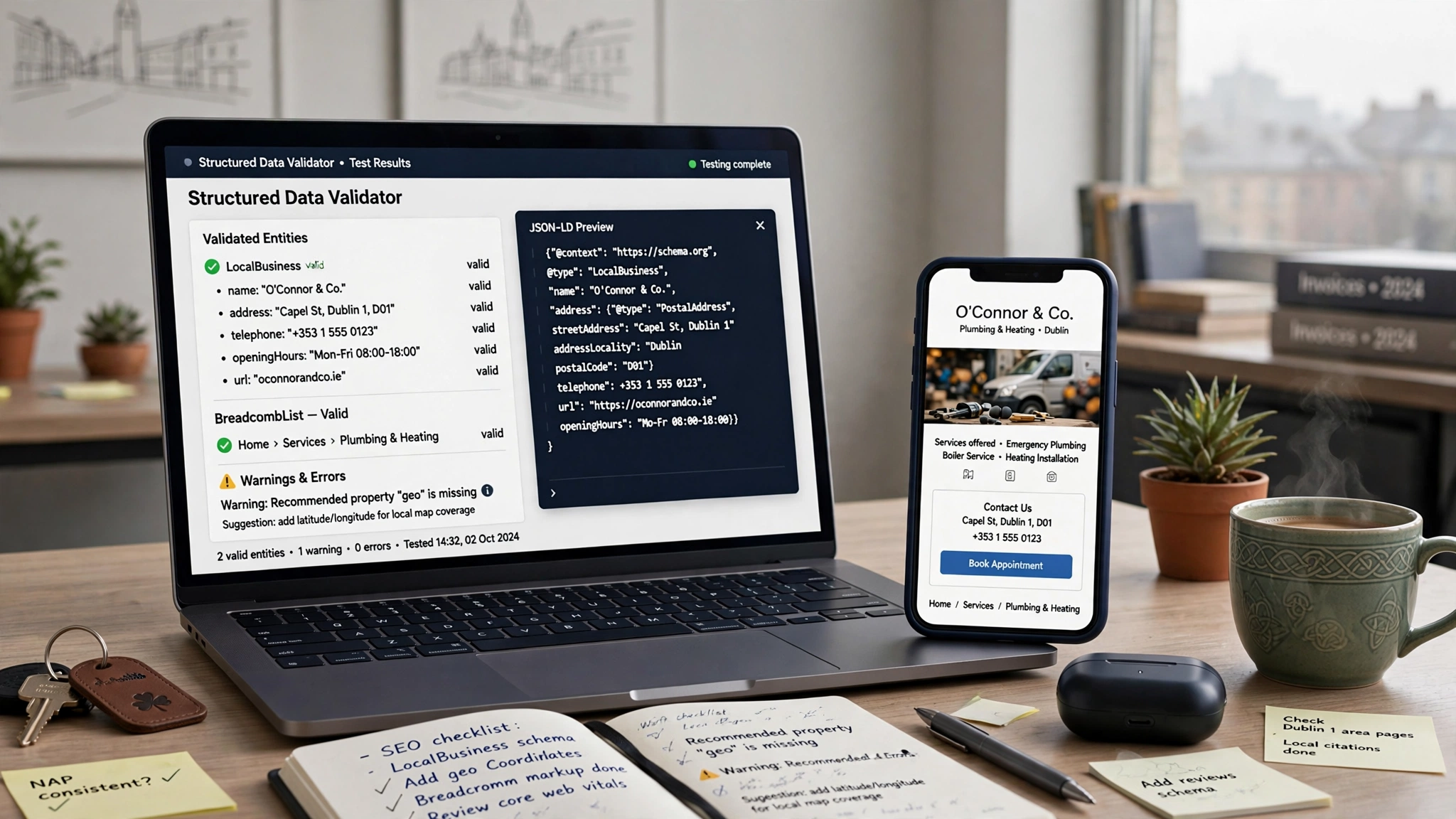
- Google’s Rich Results Test — enter a page URL to see which rich results it is eligible for and whether the markup parses correctly. Note that since mid-2026 it no longer reports on FAQ rich results.
- Schema Markup Validator — checks your markup against the schema.org vocabulary itself, catching structural errors the Rich Results Test does not.
- Google Search Console — the Enhancements section reports on the structured data Google has actually detected across your site, including errors and warnings over time.
Test your homepage first, then your most important service pages. Re-test after any change to your business details — a new phone number or changed opening hours should be updated in the markup, on the page and on your Google Business Profile together.
Common Schema Mistakes Irish Businesses Make
| Mistake | Why it hurts |
|---|---|
| Marking up content that is not on the page | Google’s policies require markup to match visible content. Hidden or invented details get the markup ignored. |
| Self-serving review stars | Marking up your own reviews disqualifies the page from review rich results and risks a spam flag. |
| Wrong business subtype | A solicitor marked up as a generic “LocalBusiness” — or worse, the wrong trade — confuses classification. |
| Duplicate markup from plugin + theme | Two or three competing LocalBusiness blocks with slightly different details contradict each other. |
| Stale details | Old phone numbers, former addresses or pre-Covid opening hours in the markup erode trust in all of your entity data. |
| Expecting FAQ rich results in 2026 | Retired by Google in May 2026 for ordinary sites; effort is better spent on LocalBusiness and Service markup. |
| Chasing exotic schema types | Most small businesses gain nothing from marking up content types they do not publish. |
Schema and AI Search: Why This Matters More in 2026
Search is no longer only ten blue links. When someone asks ChatGPT or Perplexity for “an emergency plumber in Cork open now”, the answer engine must resolve real-world entities — businesses with names, locations, hours and phone numbers — before it can recommend one.
Clean LocalBusiness and Service markup, consistent NAP details and clearly structured service pages are exactly the signals these systems consume. Schema will not single-handedly get you cited, but it removes a class of ambiguity that keeps many small businesses invisible to AI answers. If being the named answer matters to your business, this is foundational work — the same ground covered by professional AEO and GEO services.
How Long Before Schema Markup Shows Results?
Set expectations honestly. The Rich Results Test reflects your changes immediately — it reads the live page. Search Console enhancements typically update within days as Google recrawls, though it can take a few weeks on rarely crawled pages.
Visible changes in search results take longer and are never guaranteed. Breadcrumb displays may appear within weeks once Google trusts the markup. There is no fixed timeline, and schema alone does not move rankings — it is one clarity signal among many. If nothing changes after two months, the issue is rarely the markup itself; it is usually thin content, weak relevance or missing reviews elsewhere.
Frequently Asked Questions
What is local business schema markup in simple terms?
It is a small block of code on your website that describes your business — name, address, phone number, opening hours, services and location — in a standard format search engines fully understand. It removes guesswork about what your business is and where it operates.
Which schema types does a local business need?
Most Irish local businesses need LocalBusiness (using the most specific subtype, such as Plumber, Electrician or Dentist), Organization for the brand, Service for individual offerings, and BreadcrumbList for site structure. FAQ markup is optional since Google retired FAQ rich results in May 2026.
Does schema markup improve Google rankings?
Google has not listed schema markup as a direct ranking factor. It helps Google understand your business and can make you eligible for enhanced search displays such as breadcrumbs. Think of it as removing obstacles rather than gaining a boost.
Can I add star ratings to my own website with schema?
No — not for reviews of your own business. Google’s guidelines state that pages using LocalBusiness or Organization markup are ineligible for review rich results when the business controls the reviews about itself. Keep earning genuine reviews on your Google Business Profile instead.
How do I check if my schema markup is working?
Use Google’s Rich Results Test for eligibility and parsing, the Schema Markup Validator for vocabulary errors, and Google Search Console’s Enhancements reports to monitor what Google detects across your site over time.
Do I still need FAQ schema in 2026?
There is no Google rich-result benefit any more: FAQ rich results were retired in May 2026 except for well-known authoritative government and health sites. Keep writing helpful FAQ content for visitors and AI answer engines, but do not add FAQ markup expecting expanded listings.
The Takeaway
For most Irish local businesses, schema markup comes down to a short checklist:
- Add LocalBusiness markup with your real name, address, Eircode, phone, hours and service area — using the most specific business subtype.
- Add Organization markup for your brand and Service markup for what you sell.
- Add BreadcrumbList markup for clean site structure.
- Do not mark up your own reviews.
- Validate everything with the Rich Results Test and Search Console, and keep details in sync everywhere.
It is not glamorous work, but it is the kind of foundational clarity that compounds: better understanding today, eligibility for enhanced displays tomorrow, and a business entity that both Google and AI answer engines can resolve with confidence.
If you would like schema markup set up correctly as part of a wider technical SEO plan, contact our SEO team or see our managed SEO service.