AI Search Visibility: Why Top Rankings Miss AI Answers
If you run a business in Ireland and you rank first on Google for your main service, you probably assume customers will find you. That assumption is now worth checking. AI search visibility is a different contest from classic rankings, and new findings show the businesses AI answers cite most are not always the ones at the top of the search results. I check both in my audits.
This comes from measurement work released this week. Here is what the findings say, why a top ranking does not win an AI citation, what AI search visibility means for an Irish business, and the checklist I now use in my audits.
What netpulse AG found
Swiss agency netpulse AG released new findings from its own measurement work tracking how companies appear in AI-generated answers, reported on 24 October 2026. The team looked at four systems: ChatGPT, Perplexity, Google AI Mode and Google AI Overviews. Their headline finding is simple and uncomfortable: the companies most frequently cited in AI answers are not always the ones ranking highest in conventional search listings. Generative systems summarise and attribute sources differently than classic result pages do, as reported by netpulse AG.
This is one agency’s own measurement work, not a statement from Google. But it lines up with what I see in my own checks: a customer asks a question, the system answers in its own words, and it names the businesses its sources support. The business named is often not the one at the top of Google. The ranking and the citation are decided by different systems, using different evidence.
The same study found a language gap. In Switzerland’s German, French and Italian language regions, a brand can perform well in one region while being largely absent from AI answers in another. The pattern repeats wherever customers search in more than one language, and Ireland is no exception. Each language is its own contest, and a page that only exists in one language cannot be cited in another.
Why a top ranking does not win an AI citation
A classic ranking rewards a page that matches a search query well: the right words, strong links, a fast page, a trusted domain. An AI answer rewards a page the system can quote with confidence. A page can rank well because it is long and well linked, yet never be cited because its key facts are buried, vague or inconsistent across the web.
Each AI system also picks its own sources. Perplexity cites six to nine references per answer on average, and 93.2% of its answers carry a citation, per a checklist published this week. But only 11% of the domains ChatGPT cites are also cited by Perplexity. Each engine has to be won separately, and no single fix covers every system.
Access is the first gate, and it is the one most businesses never check. AI companies run different fetchers, and each answers to its own robots.txt rule. OpenAI says plainly that sites opting out of OAI-SearchBot “will not be shown in ChatGPT search answers”. A business can rank well on Google, block the wrong bot by accident, and never appear in an AI answer at all. As I wrote in my post on ChatGPT citations, help pages and documentation now make up 33.5% of the URLs ChatGPT records, while articles and guides have fallen to 9.3%. The pages AI cites answer a question directly, in plain words, at the top of the page.
The language gap Irish businesses should not ignore
Most Irish businesses think of themselves as English-language businesses, and for most of their customers that is true. But a meaningful share of searches in Ireland happen in other languages: Irish speakers, Polish, Romanian and Lithuanian communities, and visitors from Germany, France and Spain.
An AI system answering in Irish or German can only cite pages it can read in that language. If your service page exists only in English, the system will either answer from a competitor’s page in that language, or answer without naming anyone. This is not a reason to translate your whole website overnight. It is a reason to know which languages your customers actually ask in, and to make sure your most important service page exists, clearly, in each of them.
What AI search visibility means for Irish businesses
For a dentist in Galway, a roofer in Cork or a solicitor in Waterford, the practical meaning is simple. Your next customer may never see a search results page. They ask an AI assistant a question, they get an answer, and the answer names a business. If your business has no page the system can fetch, understand and quote, you are not named, however high you rank.
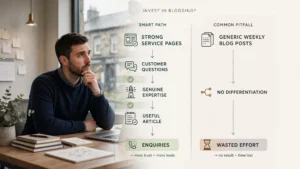
That is a different gap from a ranking drop. A ranking drop you can see in Search Console. A missing citation you cannot see: the customer simply gets an answer naming a competitor, or nobody, and moves on. In my audits, I keep finding the same pattern: plenty of blog posts and a decent ranking, but no page that simply explains the service, the process and how to book, in words a customer would actually use.
The fix is simpler than most businesses expect. You do not need to chase a new ranking or build fifty new pages. You need one clear page for each service you actually sell, written so an AI system can lift a clean answer from it. This is the core of the AEO and GEO work I do for clients: building AI search visibility by making sure AI answers can find, understand and trust your pages.
A worked example from my audits
Here is a pattern I see regularly, described as a pattern because the details repeat across clients. A dentist in Galway ranked well for implant dentistry and had published plenty of blog posts about dental health. But the practice had no dedicated page for dental implants that simply said what the treatment is, who it suits, how long it takes, what it costs to start, and how to book.
When a patient asked an AI assistant about implants in Galway, there was nothing on that site for it to cite. The blog posts did not answer the question, and the homepage mentioned implants in one line. The practice that won the mention was not the better dentist. It was the dentist with a page answering what happens, how long it takes, what it costs, and how to book.
The checklist: building AI search visibility for your business
- Ask the AI systems what they say about you. Ask ChatGPT and Perplexity the questions your customers actually ask. Note which businesses get named, and which of your pages, if any, get cited. Where a competitor appears and you do not, that gap is your work list.
- Give each service its own page. One page, one service, one set of questions answered. A page that tries to cover everything is hard to quote and easy to skip.
- Answer the real questions at the top of each page. What is it, who is it for, how does it work, how is pricing worked out, how do I book, and what happens next. Use the words customers actually use, not industry jargon.
- Make every fact on the page true, current and consistent. Opening hours, service areas, prices, phone numbers and process steps must match reality today, and must match your Google Business Profile. Basic local SEO hygiene now carries more weight than before, because AI systems cross-check what they cite.
- Check your robots.txt for AI crawlers. Confirm OAI-SearchBot, PerplexityBot and Claude-SearchBot are allowed. Blocking a training crawler is a separate decision from blocking a search crawler. Also check your Cloudflare settings for AI-crawler rules you never chose on purpose.
- Add a short FAQ section to each service page. Three to five questions, answered in two or three sentences each. This is the format AI answers draw on most easily, and it gives the system quotable lines in your own words.
- Cover the languages your customers actually use. Find out which languages your customers ask in, and make sure your most important service page exists clearly in each of them. Keep the facts identical across every language version.
FAQ: AI search visibility
Does ranking first on Google mean AI will cite me?
No. The netpulse findings show the brands AI cites most are not always the top-ranked sites. AI search visibility and classic rankings are decided by different systems using different evidence, so one does not guarantee the other.
Which AI systems should I check?
Start with ChatGPT and Perplexity, then Google AI Mode and Google AI Overviews. Each one picks its own sources: only 11% of the domains ChatGPT cites are also cited by Perplexity, so check each engine separately.
What kind of page gets cited most?
Pages that answer one question directly, at the top, in plain words: what the service is, how it works, how pricing works, how to book, and what happens next. Help pages and documentation now make up 33.5% of the URLs ChatGPT records, while articles and guides have fallen to 9.3%.
What to do next
If you rank well but AI never mentions you, start with two checks: ask ChatGPT and Perplexity what they say about your business, and read your robots.txt to confirm the AI search crawlers are allowed in. Then fix one page: your most important service, answered properly, in the words your customers use. The businesses that win AI search visibility will not be the ones with the most content, but the ones whose pages answer the exact question the customer just asked. That lesson also sits behind Google’s October 2026 AI content rules: clear, checked facts win in both classic search and AI answers. If you want someone to check it on your business, get a free SEO review at kjkseo.com.