If you run a business in Ireland and you have spent the last few years building up a blog, I have news that may change where your next hour of website work should go. ChatGPT citations have shifted, and the shift is large. The pages ChatGPT now reaches for most are not blog posts. They are help pages, documentation pages and support-style pages: the pages that answer a specific question in plain words.
This is not a rumour from a single forum post. It comes from a published report built on more than 250,000 URLs, and the numbers are clear enough that I am changing what I recommend to clients. Here is what changed, why it changed, what it means for an Irish business, and the checklist I now use in my audits.
What happened to ChatGPT citations
On 21 October 2026, SEMAI released its AI Search 2026 Report, built on more than 250,000 URLs of its own visibility data across ChatGPT, Gemini, Perplexity and Google AI Overviews. The headline finding for ChatGPT is striking. Documentation and support pages now make up 33.5% of the URLs recorded for ChatGPT, while articles and guides make up 9.3%. That is a reversal of the position in SEMAI’s February 2026 study, when documentation and support pages were just 1.4% of recorded URLs and blogs and articles were 41.2%. In other words, ChatGPT citations moved from articles to help-style pages in eight months, as reported by SEMAI.
SEMAI links the change to a model change: ChatGPT moved to a new model, while Gemini and Perplexity showed little change over the same period. SEMAI co-founder Raghunath Vijayaraghavan put it plainly: “A model change reshaped what ChatGPT cites, and it did not happen on the other engines.”
One figure has not fallen away. Company websites still appear in 79.4% of ChatGPT’s matched queries. Your own website still matters a great deal. What has changed is which pages on that website get picked up. Industry associations and professional bodies appear in 56.9% of matched queries, and public authorities in 46.4%, so credible outside mentions still count too. For the full methodology, see the SEMAI AI Search 2026 Report.
Why help pages win ChatGPT citations
A help page answers one question, directly, at the top of the page: what the service is, how it works, how pricing works, how to book, and what happens next. It does not open with a story and bury the answer in the fourth paragraph. When an AI system needs a source it can quote with confidence, that directness is an advantage.
Help pages also tend to be factual and checkable. A service page listing real opening hours, service areas and process steps can be cross-checked against other sources. A blog post full of general advice is harder to verify and easier to ignore.
One limit matters. This is a ChatGPT finding, not a whole-internet finding: in the same report, articles and guides still make up 50.6% of recorded URLs for Gemini and 44.4% for Google AI Overviews. Your blog has not become worthless. But if all your effort goes into blog posts and none into clear service pages, ChatGPT is now much less likely to cite you than it was in February.
What the ChatGPT citations shift means for Irish businesses
For a dentist in Galway or a roofer in Cork, the practical meaning is simple. A customer no longer has to visit your website for you to be mentioned. They ask ChatGPT a question, ChatGPT answers, and it cites the pages it trusts. If your business has no page that answers that question directly, you are not in the running for that citation, however good your work is.
That is a different gap from a ranking drop. A ranking drop you can see in Search Console. A missing citation you cannot see: the customer simply gets an answer naming a competitor, or nobody, and moves on. In my audits, I keep finding the same pattern: plenty of blog posts, but no page that simply explains the service, the process and how to book. Until now, that gap cost enquiries. Under the new pattern, it costs citations too.
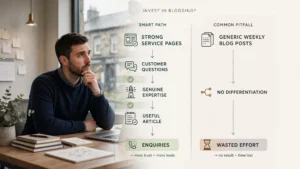
The fix is simpler than most businesses expect. You do not need to delete your blog or build fifty new pages. You need one clear page for each service you actually sell, in the words your customers use, answering the questions they actually ask. This is the core of the AEO and GEO work I do for clients: making sure AI answers can find, understand and trust your pages.
A worked example from my audits
Here is a pattern I see regularly, described as a pattern because the details repeat across clients. A Cork roofer had published more than forty blog posts over two years: storm damage advice, gutter cleaning tips, seasonal checklists. But the business had no dedicated page for emergency roof repair. No page that said what happens when you call, how quickly someone attends, what the call-out covers, or what to do while you wait.
When a homeowner asked an AI assistant what to do about a leaking roof, there was nothing on that site for it to cite. The gutter posts did not answer it, and the homepage mentioned emergency work in one line but explained nothing. The competitor who won the mention was not the better roofer. It was the roofer with a page answering what happens, how fast, what it costs to call, and how to book.
The checklist: winning ChatGPT citations for your business
- Give each service its own page. One page, one service, one set of questions answered.
- Answer the real questions at the top of each page. What is it, who is it for, how does it work, how is pricing worked out, how do I book, and what happens next. Use the words customers actually use, not industry jargon.
- Write in plain words, and keep each answer short. One question, one direct answer, then the detail. AI systems quote pages they can lift a clean answer from.
- Make every fact on the page true and current. Opening hours, service areas, prices, phone numbers and process steps must match reality today, and must match your Google Business Profile. Basic local SEO hygiene now carries more weight than before.
- Add a short FAQ section to each service page. Three to five questions, answered in two or three sentences each. This is the format AI answers draw on most easily.
- Do not delete your blog, but stop treating it as the whole strategy. Articles still matter for Gemini, Google AI Overviews and classic search. Keep writing them, but fund the service pages first.
- Check what credible outside sources say about you. Industry associations appear in 56.9% of ChatGPT’s matched queries in this report, and public authorities in 46.4%. A listing or membership page from a body your customers trust still helps.
- Review each service page once a quarter. Services, prices and areas change, and a stale help page stops being citable. I include this check in managed SEO audits because pages drift, unnoticed, until enquiries fall.
FAQ: ChatGPT citations
Has ChatGPT stopped citing blogs completely?
No. Articles and guides still make up 9.3% of ChatGPT’s recorded URLs in the report, down from 41.2% in February 2026. Blogs are cited far less often, but they are not gone, and they still matter for Gemini and Google AI Overviews.
What kind of page should I build first?
Your most important service page: the service that brings in the most enquiries. Give it one page answering what it is, how it works, how pricing works, how to book, and what happens next, in plain words.
Does this mean my blog was a waste of time?
No. Blog posts still support classic search and other AI engines, and still show expertise. The change is one of balance: service and help pages now deserve the first call on your time.
How do I know if ChatGPT cites my business?
Ask ChatGPT the questions your customers actually ask, and see which businesses and pages it names. Repeat the test for each service: where a competitor’s help page appears and yours does not, that gap is your work list.
What to do next
If your website is mostly blog posts with thin service pages, start this week with one page: your most important service, answered properly. The businesses that win ChatGPT citations will not be the ones with the most content, but the ones whose pages answer the exact question the customer just asked. That lesson also sits behind Google’s October 2026 AI content rules: clear, checked facts win in both classic search and AI answers. If you want someone to check it on your business, get a free SEO review at kjkseo.com.