If customers ask ChatGPT, Perplexity or Google an important question about your service, does your business appear in the answer?
You can check this yourself.
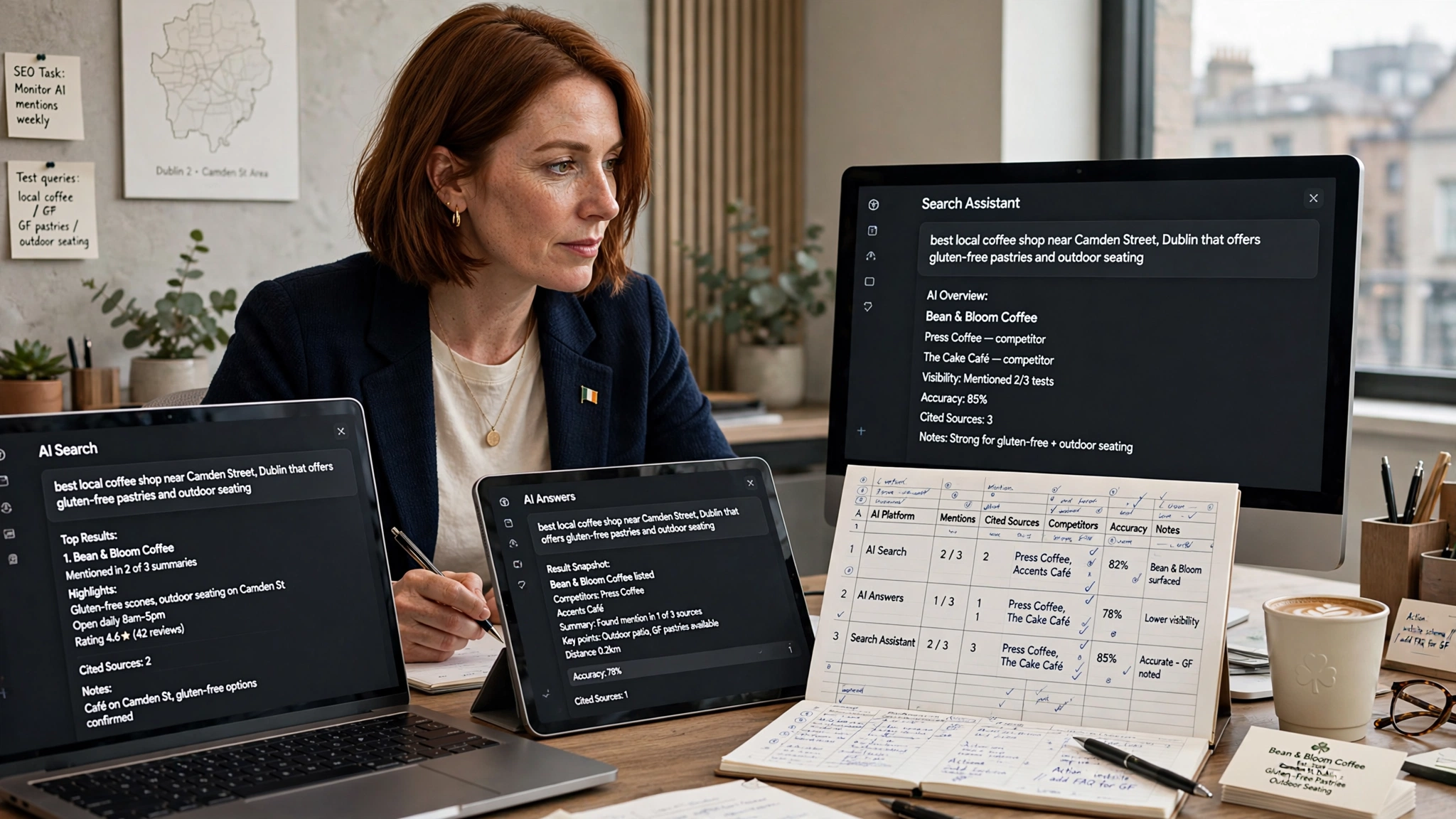
The simplest approach is to ask each platform a consistent set of realistic customer questions, record exactly what it says and which sources it cites, then repeat the same tests over time.
This gives you a practical AI search visibility check. It is not an official ranking report, because AI answers can vary by platform, query, location, language and date.
The useful part is not whether you appear once.
It is discovering:
- Which questions produce mentions of your business
- Which sources AI systems rely on
- Whether your business information is accurate
- Which competitors are being mentioned instead
- Which websites and directories appear repeatedly
- Where your own website is missing from the information ecosystem
Check AI Search Visibility: What It Means
AI search visibility is your business’s ability to be mentioned, cited or linked when someone asks an AI-powered search system a relevant question.
That can include:
- Your business being named in an answer
- Your website being cited
- A directory listing about your business being cited
- A review or third-party website being referenced
- Your business details appearing in a local recommendation
- Your business being mentioned with inaccurate information
That last point matters.
Being mentioned is not automatically a success if the AI says you are based in the wrong town, provides an old phone number or claims you offer a service you no longer provide.
Accuracy is part of AI search visibility.
Traditional Google Rankings vs AI-Generated Answers
| Traditional Google Search | AI-generated answers | |
|---|---|---|
| Format | Links, organic results, maps and other search features | Written response with links or cited sources |
| Consistency | Can vary by location, device and user | Can vary substantially by query, platform, date and context |
| Measurement | Search Console and rank-tracking tools | Manual testing plus referral and Search Console data |
| What you control | Your website, Business Profile, content and other signals | The same underlying information, but not how an AI system selects or summarises it |
| Main question | Where does my page appear? | Does the system mention or cite my business when relevant? |
Google says its AI Overviews and AI Mode use its existing Search systems to surface relevant links and may use “query fan-out” to explore related searches and sources. Google also says there are no additional technical requirements or special AI schema requirements for appearing in these features beyond the normal requirements for Google Search.
That means AI visibility is not a completely separate SEO universe.
Your technical SEO, crawlability, indexability, content quality, internal linking and business information still matter.
Why AI Platforms Give Different Answers
You can run exactly the same question through three platforms and get three different answers.
That is normal.
Different sources
Google, ChatGPT and Perplexity do not necessarily retrieve information from exactly the same sources.
ChatGPT Search can use third-party search providers and can rewrite a user’s question into one or more targeted searches before producing an answer.
Perplexity has its own crawler and published crawler guidance, while Google uses its own Search systems and index.
Location
Local questions can produce different results depending on the location associated with the search.
OpenAI says ChatGPT may use approximate location information to improve local search results and may rewrite a query using that general location.
That is particularly important for Irish businesses.
“Best electrician in Ireland” and “best electrician near Galway” are different tests.
Query wording
These questions may produce different results:
- “What are some plumbers in Galway?”
- “Which plumbing companies serve Galway?”
- “Who installs boilers in Galway?”
- “Which local plumber should I contact for an emergency?”
Do not test only one wording and assume it represents your entire AI visibility.
AI answers change
AI search systems can change their answers as their underlying search results, sources and systems change.
Google also notes that AI Overviews do not appear for every query. They are shown when Google’s systems determine that the feature adds value beyond traditional Search.
So:
One test on one day is a snapshot, not a verdict.
The AI Search Visibility Testing Process
Use the same basic workflow every time:
Choose a query → Run the prompt → Record the result → Check the sources → Compare platforms → Identify gaps → Improve the information → Re-test
1. Choose your queries
Build a small testing set covering:
- Branded searches
- Service searches
- Location searches
- Specific service + location searches
- Customer research questions
2. Run the prompts consistently
For each platform:
- Use the same wording
- Start a new conversation where practical
- Record whether you were logged in
- Record the location you were testing from
- Note the date and time
- Record whether web search was active where applicable
Consistency makes the results more useful over time.
3. Record the answer
Do not just write “yes” or “no.”
Record:
- Was the business mentioned?
- Where did it appear?
- What did the platform say?
- Was a link provided?
- Was your website cited?
- Which third-party sources were cited?
- Were competitors mentioned?
- Was the information accurate?
4. Check every cited source
This is one of the most valuable parts of the exercise.
Click the sources.
You may discover that AI repeatedly relies on:
- A business directory
- A review platform
- A local publication
- A trade association
- A competitor comparison
- Your own website
- A local news article
Those sources can reveal where the AI system is getting its understanding of your business.
5. Compare platforms
Look for patterns.
If Google, ChatGPT and Perplexity all identify the same competitor, investigate what information those systems are finding about that competitor.
If one platform mentions you but another does not, investigate the source differences.
6. Identify the biggest gap
The gap might be:
- Missing information
- Incorrect information
- Weak service relevance
- Missing local evidence
- Poor directory coverage
- Crawl restrictions
- Thin service pages
- Outdated business details
7. Improve and re-test
Make the most useful correction first.
Then run the same prompts again later.
Do not change ten things simultaneously if you want to understand what actually changed.
Five Practical Prompts to Check AI Search Visibility
Use prompts that resemble what a real customer might ask.
1. Broad local service query
“What are some [service] providers in [Irish city]?”
Example:
“What are some plumbers in Galway?”
This tests broad local visibility.
2. Specific local service query
“What businesses provide [service] in [location]?”
Example:
“What businesses provide home care in Naas?”
This tests whether the business is associated with a particular service and location.
3. Research question
“What should I look for when choosing a [service] in Ireland?”
Example:
“What should I look for when choosing a solicitor in Ireland?”
This tests whether your informational content is being surfaced for a broader customer decision.
4. Specific service + location
“Which local businesses provide [specific service] near [location]?”
Example:
“Which local businesses provide EV charger installation near Kilkenny?”
This is useful for testing a high-intent niche service.
5. Branded accuracy query
“What information is available online about [business name]?”
Example:
“What information is available online about Byrne Plumbing & Heating in Tuam?”
This tests how an AI system understands the business across the web.
Tip: Add the town, county or service to branded searches.
Irish business names can be similar, and AI systems may confuse businesses operating in different locations.
How to Test ChatGPT
Turn on web search where available and run your prompts consistently.
ChatGPT Search provides links to sources, and OpenAI says websites can appear in ChatGPT Search when they allow OAI-SearchBot to crawl their content. OpenAI also says sites that opt out of OAI-SearchBot will not be shown in ChatGPT search answers, although navigational links may still appear. See OpenAI’s crawler documentation.
Record:
- Businesses mentioned
- Your position or context in the answer
- Sources linked
- Whether your own website was cited
- Whether a map or other local information appeared
- Accuracy of the business details
Check OAI-SearchBot access
If your website never appears in ChatGPT Search, check whether your robots.txt, firewall, CDN or other security layer is preventing OAI-SearchBot from accessing the relevant pages.
OpenAI specifically recommends allowing OAI-SearchBot if you want public website content to be discoverable and cited in ChatGPT Search.
How to Test Perplexity
Run the same prompts in a new thread and record the answer and cited sources.
Perplexity publishes crawler documentation covering its web crawlers, including PerplexityBot and Perplexity-User. Its guidance explains how website owners can control crawler access through robots.txt and related infrastructure.
Record:
- Businesses mentioned
- Sources cited
- Whether your website appears
- Which directories or publications are repeatedly cited
- Competitors mentioned
- Any inaccurate information
If your website is absent, check your robots.txt and server/CDN controls before assuming that the problem is content quality.
How to Test Google AI Overviews and AI Mode
Search the same prompts in Google.
Some searches may show an AI Overview. Others may not.
If AI Mode is available to you, test there as well.
Record:
- Whether an AI Overview appeared
- Whether your business was mentioned
- Which links were shown
- Which sources supported the answer
- Your normal organic position
- Your local/map visibility
- Whether competitors were cited
Google says pages need to be indexed and eligible to appear with a Search snippet to be eligible as supporting links in AI Overviews or AI Mode. There are no additional technical requirements beyond Google’s normal Search requirements.
Google also says AI Overviews and AI Mode are included in Search Console’s Performance reporting, with dedicated Generative AI reporting rolled out worldwide in 2026.
That makes Google the platform where you can combine manual visibility checks with Google’s own performance data.
Record Every Test
A simple spreadsheet is enough.
| Date | Platform | Prompt | Logged in? | Location | Mentioned? | Context | Accurate? | Sources cited | Competitors | Notes |
|---|---|---|---|---|---|---|---|---|---|---|
| 01/10/26 | ChatGPT | “Plumbers in Galway” | No | Galway | Yes | 3rd of 5 | Yes | Own site, directory | A, B, C | Map shown |
| 01/10/26 | Perplexity | “Plumbers in Galway” | No | Galway | No | — | — | Directory X, Reddit | A, B | — |
| 01/10/26 | Google AI Overview | “Plumbers in Galway” | No | Galway | No AIO | — | — | — | — | Map Pack: position 2 |
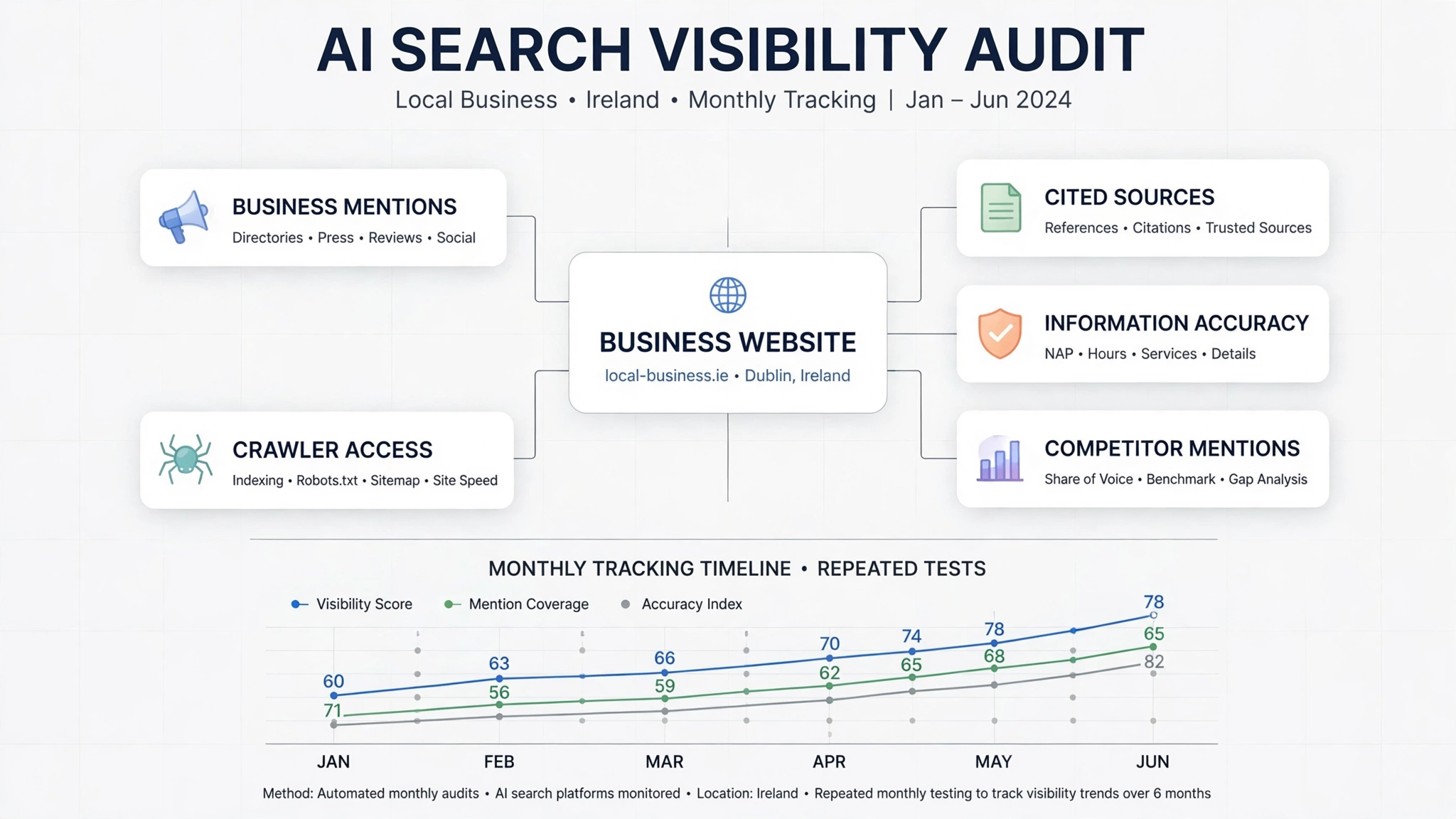
Repeat the same prompts monthly.
Do not overreact to one month’s result.
Look for patterns over three to six months.
Check Which Sources AI Systems Mention
The cited sources can be more useful than the mention itself.
Ask:
Which directories appear repeatedly?
If several AI answers cite the same Irish business directory and your business is absent, that may be worth investigating.
Which websites are cited for informational questions?
If AI repeatedly cites particular industry publications or authoritative guides, examine the type of information those sources provide.
Are review websites appearing?
Look at whether review platforms are contributing to the AI system’s understanding of businesses in your category.
Is your own website being cited?
If it is not, ask:
- Is the relevant information actually on your site?
- Is the page indexable?
- Is the service clearly explained?
- Is the content useful enough to answer the question?
- Are important pages internally linked?
- Is the information current?
Do not assume that a missing citation automatically means your site has an SEO problem.
Review the Accuracy of Your Business Information
AI visibility without accuracy is not a useful success metric.
Check what AI systems say about:
| Item | Common problem |
|---|---|
| Business name | Confused with a similarly named company |
| Location | Old address or wrong town |
| Phone number | Outdated number |
| Opening hours | Old or incorrect hours |
| Services | Missing or discontinued services |
| Prices | Outdated or unsupported figures |
| Business status | Closed branch described as open |
| Qualifications | Incorrect claims about licences or accreditations |
| Specialisms | Services attributed to the wrong business |
If an AI tool provides incorrect information, find the source it appears to rely on.
Then correct the underlying information wherever you legitimately control it.
That may include:
- Your website
- Google Business Profile
- Relevant directories
- Professional listings
- Industry profiles
- Social profiles
- Other authoritative references
AI systems may not reflect corrections immediately.
Re-test rather than expecting an instant change.
Identify Content and Information Gaps
Use your testing log to categorise what you find.
| What you find | Possible gap | What to investigate |
|---|---|---|
| Not mentioned for relevant queries | Weak relevance or discoverability | Technical SEO, service pages, Business Profile and listings |
| Mentioned only for branded queries | Weak service/location association | Service pages, local pages and supporting content |
| Mentioned with incorrect details | Inconsistent information | Website, directories and outdated listings |
| Competitors cited from a directory you are absent from | Missing third-party source | Relevant industry or local directories |
| Your guides are never cited | Content may not answer the question strongly enough | Practical guides, FAQs and original information |
| Mentioned on one platform but not another | Different retrieval sources | Crawler access and platform-specific source coverage |
These are diagnostic hypotheses, not guaranteed causes.
An AI system can fail to mention a business for many reasons, and a single test cannot establish why.
Improve Your Website and Online Information
Start with fundamentals rather than chasing an “AI hack.”
Google’s current guidance says the same foundational SEO practices remain relevant for generative AI features: allow crawling, make important content accessible, use clear internal links, provide helpful and reliable content, keep Business Profile information up to date and ensure structured data matches visible content. Google also says there is no special AI schema or AI text file required to appear in AI Overviews or AI Mode.
For a local business, that means prioritising:
- Accurate business information
- A complete Google Business Profile
- Strong service pages
- Useful location pages where appropriate
- Genuine customer reviews
- Original project information
- Clear internal linking
- Crawlable pages
- Consistent information across important third-party sources
Do not assume that FAQPage schema, llms.txt or another emerging tactic guarantees AI citations.
Google explicitly says there is no special schema or AI text file required for its AI features.
Track Real Visits From AI Tools
Visibility is interesting.
Traffic and enquiries are what make it commercially useful.
ChatGPT
OpenAI says ChatGPT referral URLs include:
utm_source=chatgpt.com
That makes ChatGPT referrals identifiable in analytics platforms such as Google Analytics.
Other AI platforms
Review your analytics referral data for traffic from platforms such as Perplexity.
Don’t assume every AI visit will be perfectly attributed. Referral behaviour and privacy settings can affect what appears in analytics.
Google AI features
Google says traffic from AI Overviews and AI Mode is included in Search Console’s Performance reporting, with dedicated Generative AI reporting now available.
Ask customers
Add a simple question to your enquiry process:
“How did you hear about us?”
Where appropriate, include options such as:
- Google Search
- Google Maps
- Referral
- Social media
- ChatGPT or another AI assistant
- Other
Customer answers can reveal visibility that analytics alone cannot.
When This May Not Apply
Very new businesses
A new business may have too little established information online for AI systems to understand it reliably.
Start by building the underlying information rather than obsessing over AI mentions.
Referral-led businesses
If most customers come through existing relationships, AI search may generate little direct traffic.
That does not mean the visibility exercise has no value. Accurate online information can still help potential customers who research your business before contacting you.
Businesses in rapidly changing markets
AI search features are evolving quickly.
The prompts, interfaces, sources and measurement tools available today may change.
Treat your testing process as an ongoing measurement system rather than a permanent ranking formula.
For a broader strategy, see our AEO and GEO services or contact us for an AI search visibility review.
FAQ
How do I check if ChatGPT recommends my business?
Turn on web search where available and ask realistic customer questions such as:
“What are some [service] providers in [town]?”
Record whether your business is mentioned, what the answer says and which sources are cited. Repeat the same test regularly.
OpenAI says website inclusion in ChatGPT Search depends in part on allowing OAI-SearchBot to crawl the site.
Why does my business appear in one AI tool but not another?
Different platforms can use different retrieval systems, sources and query processes.
ChatGPT Search can rewrite queries and use search partners, while Google and Perplexity have their own systems and sources.
Location, wording and timing can also change the result.
Are AI visibility checks the same as rankings?
No.
A manual AI visibility test is a snapshot of what a particular system produced for a particular question at a particular time and context.
It should not be treated as an official ranking report.
Use repeated tests alongside Search Console, analytics and actual enquiries.
What should I do if AI gives wrong information about my business?
Identify the information that is wrong and, where possible, the sources contributing to it.
Then correct the underlying information on your website and relevant business listings.
After making corrections, re-test later.
There is no guarantee that an AI system will immediately update its answer.
Do Google AI Overviews appear for every search?
No.
Google says AI Overviews are shown when its systems determine they add value beyond traditional Search, so they do not trigger for every query. Pages also need to be indexed and eligible to appear with a Search snippet to be eligible as supporting links.
The Takeaway
This week, run five realistic customer prompts across ChatGPT, Perplexity and Google.
Then:
- Record exactly what each platform says.
- Save every cited source.
- Check whether your business information is accurate.
- Identify which competitors and third-party sources appear repeatedly.
- Fix the biggest information or technical gap you find.
- Repeat the same tests next month.
You cannot control exactly what an AI system will say about your business.
You can control how accurate, useful, consistent and discoverable your business information is across the web.
That is what makes an AI search visibility check useful: not chasing a one-off mention, but finding and improving the information systems use to understand your business.
Sources: Google: AI features and your website · OpenAI: crawler documentation · Perplexity: crawler documentation