
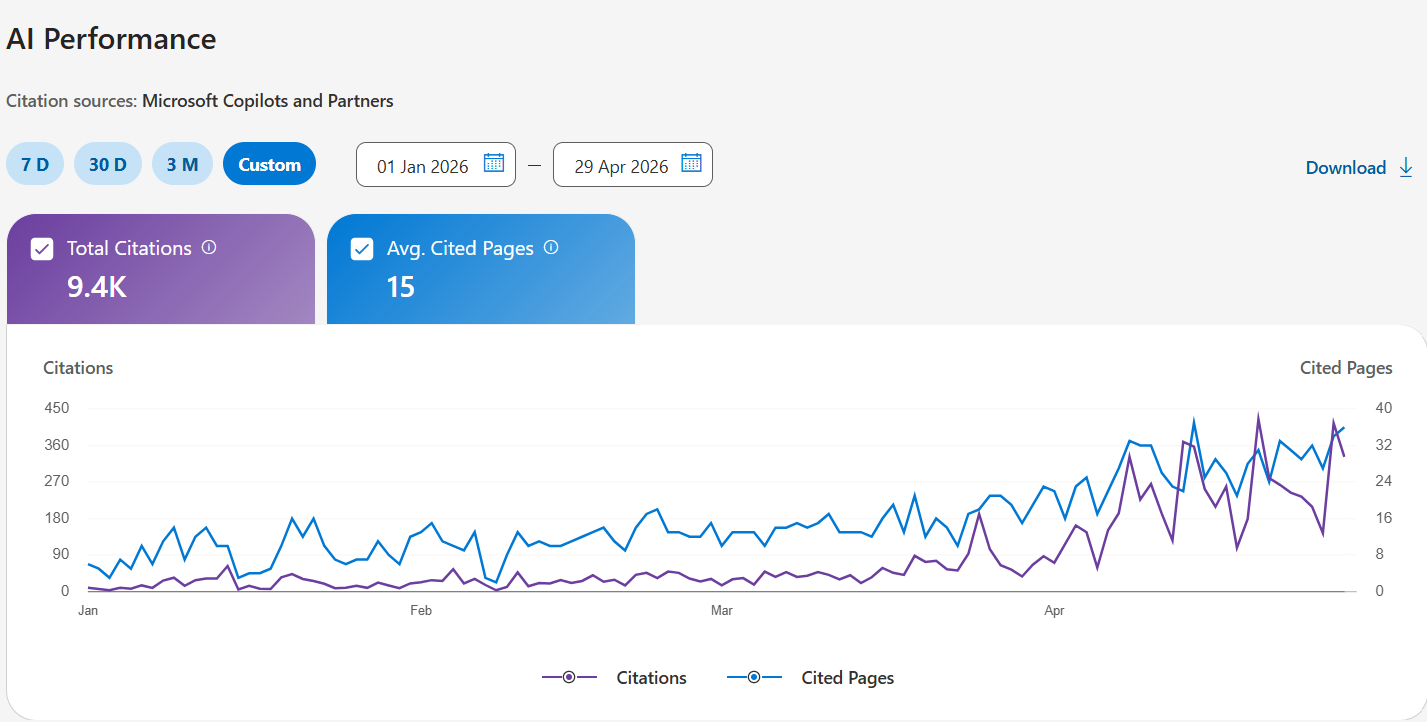
This AEO GEO case study breaks down how a US-based B2B eCommerce brand moved from negligible AI visibility to 9,400 total citations and an average of 15 cited pages per citation event across Microsoft Copilot and its partner network, over a four-month tracking window from January to late April.
The two metrics tracked tell different parts of the story. Citations measure how often the brand’s content was directly referenced inside an AI-generated answer. Cited pages measure how many distinct pages on the site were being pulled into those answers — a proxy for how deeply the AI engine trusts the site’s content architecture, not just one hero page.
For the first ten weeks, both metrics moved in a flat, noisy band — citations hovering near single digits to low double digits, cited pages oscillating between 90 and 180. Then, starting in early April, both lines broke out: cited pages climbed past 360, and citations spiked from a flat baseline to over 30 per period, with one peak crossing 40. That inflection point is the signature of a GEO strategy compounding, not random variance.
Why Most eCommerce Brands Are Invisible to AI Engines
Traditional SEO optimizes for ranking in a list of ten blue links. Generative Engine Optimization optimizes for being the source an AI model pulls a fact, a recommendation, or a comparison from — and most eCommerce product and category pages are structurally unreadable to an AI summarizer.
Thin product descriptions, no clear entity definitions, no structured comparison data, and no content written to directly answer a buyer’s question mean there’s nothing extractable for Copilot or its partners to cite.
This brand started in exactly that position: technically indexed, but functionally absent from AI-generated answers, because nothing on the site was built to be lifted into a generative response.
The GEO Strategy Behind the Citation Growth
The work centered on restructuring content for extractability — the core mechanic any AEO GEO case study worth reading has to address.
Product and category pages were rewritten around clear, self-contained factual statements: direct comparisons, specification call-outs, and answer-formatted paragraphs that an AI model could lift cleanly without needing surrounding context.
Entity clarity was reinforced through structured data — Product, Organization, and FAQ schema — giving AI crawlers an unambiguous map of what each page was actually about. According to Microsoft’s own documentation on Bing and Copilot crawlers, structured, well-categorized content is a key factor in how its systems identify authoritative source pages.
A dedicated comparison and buying-guide content layer was added specifically because generative engines favor pages that resolve a decision rather than promote a single product — these became some of the most frequently cited pages in the dataset.
Internal linking was rebuilt to connect supporting content directly into commercial pages, increasing the surface area of pages an AI engine could discover and trust as interconnected, not isolated.
Reading the Inflection Point
The flat first ten weeks weren’t wasted time — they were the indexing and trust-building window every AEO GEO case study involving a previously low-authority domain has to pass through before generative engines begin treating the site as a reliable source.
Citation behavior in AI engines tends to compound rather than grow linearly: once a domain crosses a trust threshold, the same engine reuses it repeatedly across related queries, which is exactly the near-vertical pattern visible from early April onward.
What This Means for B2B eCommerce Brands
AI Overviews, Copilot, and partner answer engines are an increasingly large share of how buyers research before they ever click through to a website. A brand absent from those citations isn’t just missing traffic — it’s missing the recommendation moment entirely. See more AI SEO and Local SEO case studies for how this strategy adapts across different verticals.
The takeaway from this dataset: GEO isn’t a future tactic, it’s already measurable, and the brands investing in extractable, well-structured content now are the ones being cited while competitors remain invisible to the fastest-growing research channel in B2B buying.
FAQ: AEO and GEO for eCommerce Brands
What is the difference between AEO and GEO?
AEO (Answer Engine Optimization) focuses on getting content selected as the direct answer in search and voice results. GEO (Generative Engine Optimization) focuses specifically on being cited and referenced inside AI-generated responses from tools like Copilot, ChatGPT, and Gemini.
How long does it take to see results from a GEO strategy?
This dataset shows a roughly 10-week trust-building period before citation growth accelerated, with the steepest gains appearing in months three and four.
Does GEO replace traditional SEO?
No. GEO builds on the same technical and content foundations as traditional SEO but adds extractability, entity clarity, and structured data as additional requirements for AI engines specifically.