
Probably not in the way you’ve been told.
Most Irish small businesses do not need a blog that publishes a new article every week. They need:
- Strong service pages for the things they actually sell
- A complete and well-maintained Google Business Profile
- A small number of genuinely useful articles that answer questions customers ask before they buy
So, does my business need a blog? Sometimes. A blog is worth investing in when you can publish information that helps potential customers make a decision and draws on knowledge only your business can provide.
That might mean an honest pricing guide, a comparison between two options, a detailed answer to a question customers repeatedly ask, or a real project story.
A blog can become a waste of money when you’re publishing generic articles on a schedule simply because someone told you that “every business needs a blog.”
The real question is not whether you need a blog.
It’s:
What do my customers want to know before they contact me, and does my website answer those questions?
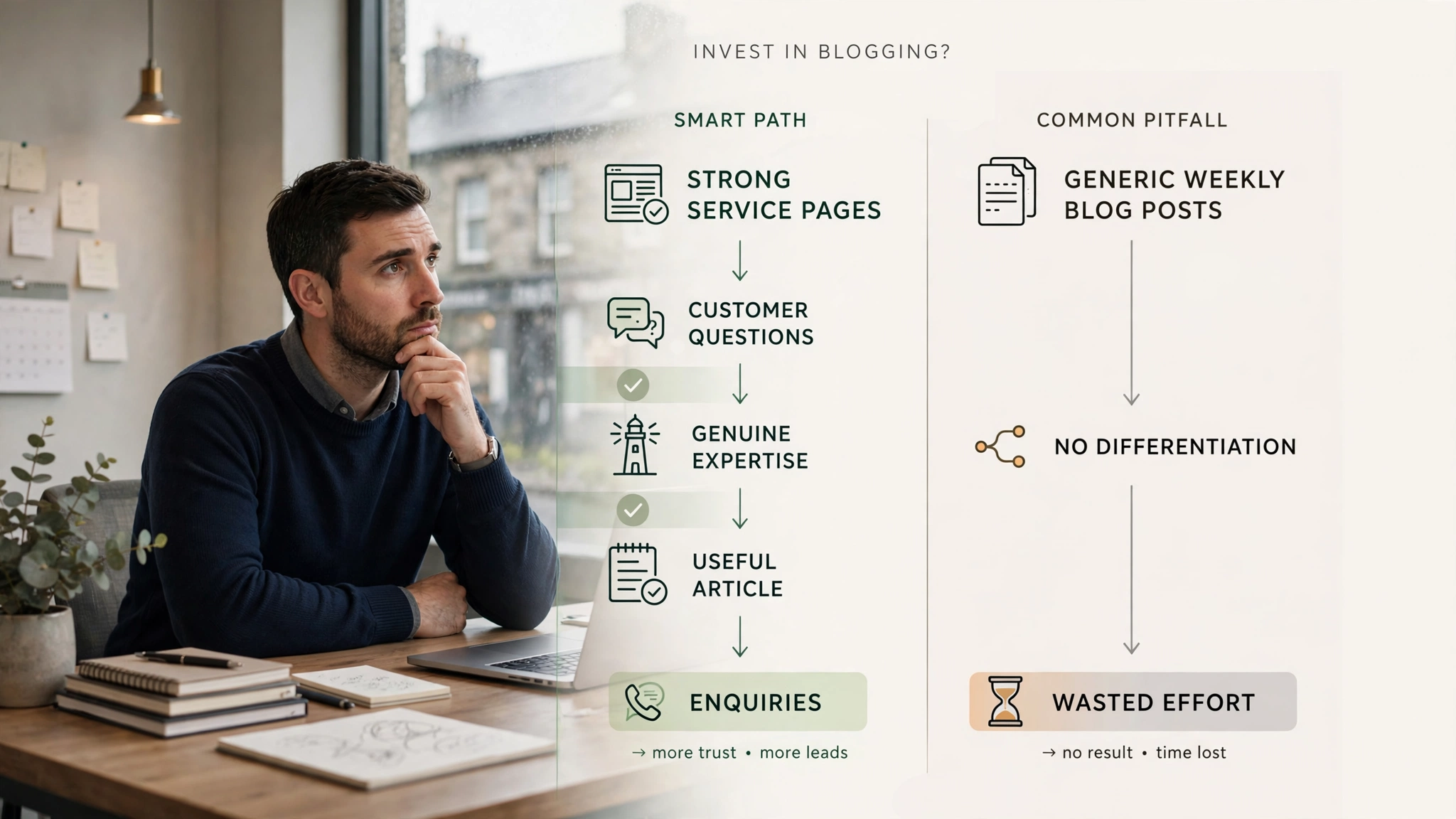
Start With Your Service Pages, Not Your Blog
Before commissioning ten blog posts, look at your core service pages.
If you are a plumber, electrician, solicitor, dentist, builder or solar installer, your main services should have clear pages explaining:
- What you offer
- Who the service is for
- What is involved
- Typical considerations or costs
- Why customers should choose you
- How to get started
If a simple customer question can be answered properly on the service page, put it there.
If the subject needs a more detailed explanation, comparison, cost breakdown or step-by-step guide, it may deserve its own article.
That creates a useful relationship between the two:
Service page = the service you’re selling.
Blog post = the information that helps someone decide whether and how to buy it.
When a Blog Is Worth It
Blogging tends to make sense when several of these conditions are true.
Customers research before buying
Some purchases happen immediately. Others involve days or weeks of research.
Think about:
- Home extensions
- Solar panels
- Heat pumps
- Dental implants
- Conveyancing
- Wedding venues
- Construction projects
- B2B services
- Professional services
Someone considering a €10,000 home improvement project may read several pages before contacting a company.
Someone with a burst pipe at 2 a.m. is much more likely to search for a plumber and call immediately.
The buying journey matters.
Customers ask you the same questions repeatedly
Every question your team answers five times a week is a potential content idea.
If customers repeatedly ask:
- How much does this cost?
- How long does it take?
- Do I need planning permission?
- Which option is better?
- What happens during the first appointment?
- What happens after I accept the quote?
you already have a list of potential articles.
You have information competitors cannot easily copy
This is where business blogging becomes much more valuable.
You may know:
- Real price ranges
- Common problems you’ve found on jobs
- Typical project timelines
- Which options work best in particular situations
- Local considerations
- Mistakes customers commonly make
- What happens during the actual process
That information creates something generic content cannot easily reproduce: first-hand experience.
Your service pages are already strong
Articles work best when they support useful commercial pages.
If your service pages are thin or unclear, publishing another article about the industry will not solve the underlying problem.
Build the commercial foundation first.
Someone can contribute genuine expertise
You don’t necessarily need a full-time writer.
A business owner or subject-matter expert can provide:
- A 20-minute interview
- Voice notes
- Job photographs
- Pricing information
- Project details
- Answers to customer questions
A writer can turn those materials into a polished article.
You do not need to become a professional blogger to create useful business content.
When a Blog Is a Waste of Money
Blogging is much less likely to justify its cost when:
- Customers generally need the service urgently.
- The posts are generic.
- Nobody in the business contributes real expertise.
- Articles are being published simply to meet a monthly quota.
- The website’s important service pages are still weak.
- Nobody measures whether the content generates useful traffic or enquiries.
- The topics have little relationship to what the business actually sells.
For example, an emergency locksmith may get more commercial value from a strong Google Business Profile, reviews, service pages and paid search than from publishing “Five Tips for Improving Home Security” every Tuesday.
That does not mean an emergency locksmith should never publish an article.
It means the article needs a clear purpose.
A simple warning sign is this:
You’re paying for monthly blog posts but cannot identify a single useful enquiry, customer conversation, search opportunity or service-page improvement they have contributed to.
What Google Actually Says About Business Content
Google’s current guidance is much closer to the approach above than to the idea that every business needs to publish constantly.
Google says the purpose of content should be to help people, rather than primarily to attract search-engine visits. It encourages original information, substantial value, first-hand expertise and content that leaves the reader able to accomplish their goal.
Google also explicitly says there is no preferred word count that its systems favour. Writing 2,000 words instead of 800 does not automatically make an article better.
Its guidance also warns against producing lots of content on many topics simply in the hope that some will perform well.
That is important for small businesses.
You do not need 100 articles because a content agency has sold you a “100-post strategy.”
You need the right articles for your customers.
What this means in practice
A useful business article should ideally contain something beyond information that could be copied from ten competing websites.
For example:
Weak:
“Here are five benefits of solar panels.”
Stronger:
“What a 4 kW solar PV system actually cost our Galway customers in 2026, what affected the price, and how the current SEAI grant changes the calculation.”
The second article has a reason to exist.
It contains information a local installer may actually know from doing the work.
If you mention current grants or regulations, always verify the details against the relevant official source before publishing. SEAI’s current solar PV guidance, for example, lists the applicable grant conditions and values and states that grant approval must be in place before work begins.
What About AI-Written Blog Posts?
AI can be useful for business content.
It can help you:
- Structure an article
- Turn notes into a first draft
- Suggest questions to answer
- Improve clarity
- Create an outline
- Identify missing sections
- Edit grammar and readability
But AI should not become a substitute for the information that makes your business worth writing about.
Google’s guidance on generative AI content says it can be useful for researching topics and adding structure to original content. It also warns that using AI or other automation to generate many pages without adding value can violate its scaled-content-abuse policies.
Google’s broader position is not “AI content is automatically bad.” Its guidance focuses on the quality, originality, usefulness and purpose of the resulting content. Using automation primarily to manipulate Search is the problem.
For a local business, that distinction is important.
AI does not know:
- What you charged for your last ten projects
- What you discovered behind a customer’s wall
- Which option you recommend after seeing hundreds of installations
- What customers in your area repeatedly get wrong
- Which photographs are from your actual jobs
- What happened when a project went differently from the original plan
You do.
That’s where the value comes from.
A useful rule is:
If a competitor could publish the same article without speaking to you, ask whether the article needs more first-hand information before you publish it.
The Five Types of Blog Posts Most Likely to Help
You do not need hundreds of posts.
For many Irish local businesses, start with these five categories.
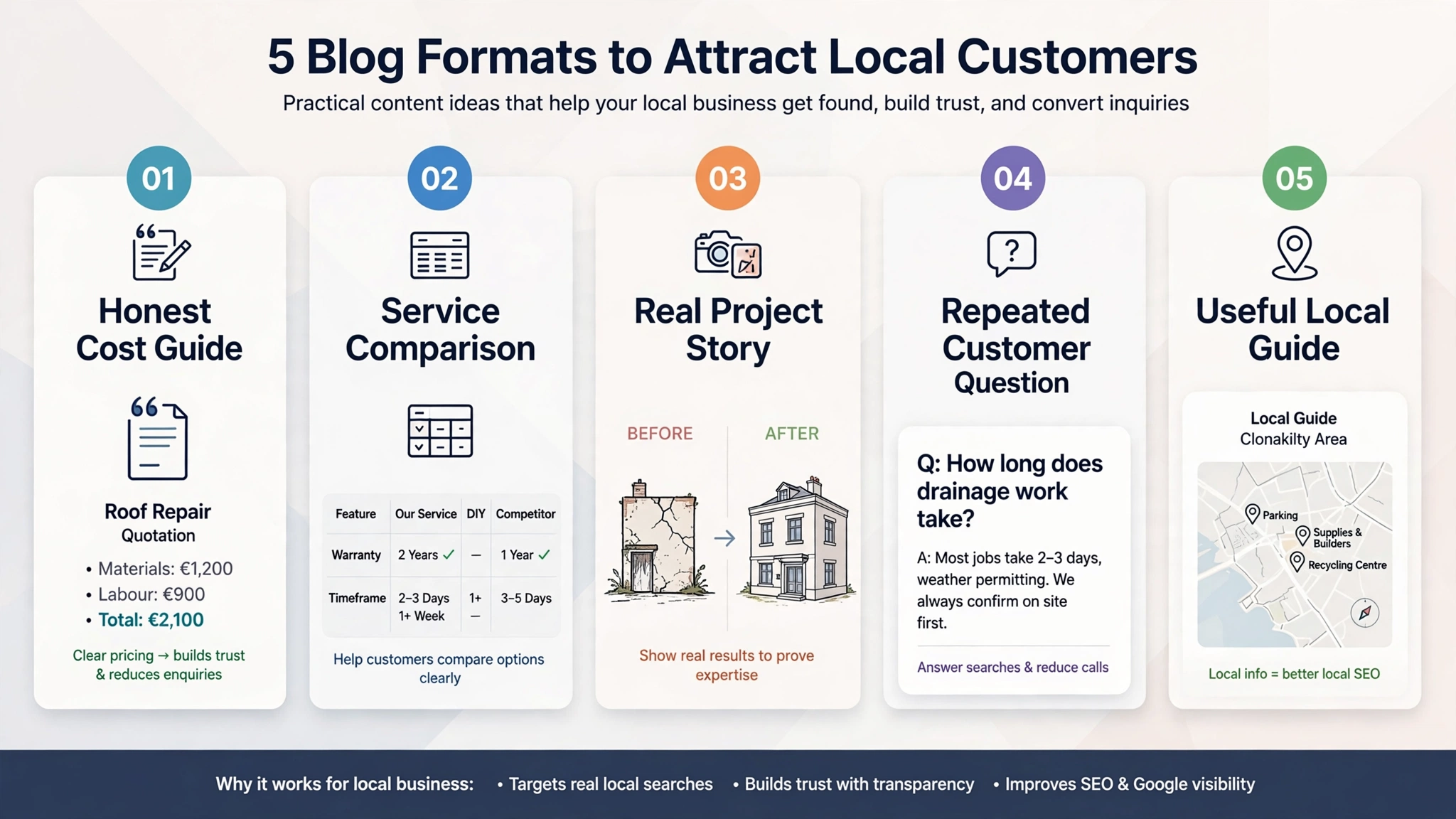
1. Honest cost guides
Examples:
- “How Much Does a Heat Pump Cost in Ireland?”
- “How Much Does a New Fuse Board Cost?”
- “How Much Does a Wedding at a Cork Venue Cost?”
A useful cost guide should explain:
- Realistic price ranges
- What changes the price
- What is included
- What is not included
- Different options
- Additional costs
- Relevant grants or schemes
- When the customer actually needs the service
Avoid inventing precise prices simply to make an article look authoritative.
If you use your own business prices, explain what they represent and keep them updated.
2. “Which Option Is Right for Me?” Comparisons
These can attract people who are actively considering a purchase.
Examples:
- Heat pump vs gas boiler for a 1990s semi
- Composite vs uPVC front doors
- Clear aligners vs braces
- Repair vs replacement
- Extension vs attic conversion
Do not turn comparisons into disguised sales pitches.
Explain the advantages and disadvantages of each option, including situations where the cheaper or simpler option may be appropriate.
That makes the article more useful and more trustworthy.
3. Real Project Stories
These are particularly valuable because they are difficult to reproduce.
For example:
“Rewiring a 1950s Farmhouse in County Laois: What We Found and What It Cost”
Include:
- The original problem
- Property type
- What you discovered
- Recommended solution
- Project timeline
- Important complications
- Before-and-after photographs
- Final result
- Customer feedback, with permission
This type of content demonstrates what your business actually does.
It is also much more difficult for a competitor to reproduce honestly.
4. Answers to Repeated Customer Questions
Take the questions your team hears every week.
Examples:
- Do I need planning permission for a garden room in Ireland?
- How long does a boiler replacement take?
- What happens during a first physiotherapy appointment?
- How long does conveyancing normally take?
- Do I need an electrician before installing an EV charger?
One genuine customer question can become a useful article.
5. Local Guides for the Right Businesses
Local guides can work particularly well for hospitality, tourism, retail and other businesses where local discovery is part of the buying journey.
For example:
“A Local’s Guide to a Rainy Day in Kinsale”
The key is usefulness.
A local guide should not be a 1,000-word advertisement disguised as an article.
Give people genuinely useful information first.
How Often Should You Publish?
There is no Google rule saying that a small business must publish every week or every month.
Google’s guidance focuses on helpful, people-first content rather than a required publishing frequency or word count.
For many small businesses, a more realistic approach is:
Start with 5–10 core articles covering your most important pre-sale questions.
Then publish when you have something genuinely useful to add:
- A new project
- A meaningful price change
- A new service
- A new grant or scheme
- A significant regulation change
- A recurring customer question
- New first-hand research or experience
And remember to update existing articles.
An accurate cost guide can be more useful than three new generic posts.
One excellent article is better than four forgettable articles simply because the calendar says it’s Thursday.
Blog Posts vs Service Pages
| Service page | Blog post | |
|---|---|---|
| Purpose | Sell a specific service | Answer a question or explain a decision |
| Search intent | Ready to hire | Researching or comparing |
| Priority | Build these first | Build once core pages are strong |
| Example | “Boiler Repair Tralee” | “How Long Does a Boiler Last?” |
| Commercial role | Direct | Supports the buying journey |
| Internal linking | Receives relevant article links | Links to relevant service pages |
Every useful commercial article should have a logical next step.
If someone reads your article about boiler replacement, link them to your boiler installation service.
If someone reads your article about dental implants, link them to the relevant treatment page.
Don’t make readers figure out where to go next.
How to Tell If Your Blog Is Working
Do not judge your blog simply by the number of articles published.
Track what happens after publication.
1. Google Search Console
Look at:
- Impressions
- Clicks
- Queries
- Average position
- Which URLs are receiving search visibility
You may discover that an article is attracting searches you did not originally target.
2. Google Analytics 4
Look at whether article visitors:
- Visit service pages
- Submit forms
- Click telephone links
- Request quotes
- Navigate deeper into the website
Traffic is useful, but commercial behaviour is usually more important.
3. Your enquiry process
Ask suitable leads:
“Did you read anything on our website before contacting us?”
If appropriate, you can also ask which article or guide they found useful.
4. Sales conversations
Listen for customers saying:
“I read your guide about…”
That is strong qualitative evidence that the content is helping the buying process.
When should you improve or remove an article?
Do not delete a post simply because it has low traffic.
Look at the whole picture.
A post with low traffic may still:
- Support an important service page
- Answer an important customer question
- Assist sales conversations
- Attract links
- Rank for valuable long-tail searches
- Help demonstrate expertise
But an article with no meaningful visibility, no business purpose and no useful role elsewhere may be a candidate for improvement, consolidation or removal.
What Does a Good Business Blog Cost?
A genuinely useful article usually requires more than typing a keyword into an AI tool.
It may involve:
- An interview with the business owner or expert
- Research
- Writing
- Editing
- Original photographs
- Data or pricing
- Fact-checking
- Internal linking
- Updates over time
That is why generic articles can be produced cheaply while genuinely useful articles take more work.
Instead of deciding:
“We need four blog posts every month.”
Decide:
“We can realistically produce one genuinely useful article each month.”
Then measure what those articles actually contribute.
Content is one part of the wider cost of SEO in Ireland, so budget for it alongside technical work and link building.
When a Blog May Not Be Your Priority
A blog should not automatically be the first SEO investment for every business.
Urgent-service businesses
Locksmiths, emergency plumbers and similar businesses may get more immediate commercial value from:
- Google Business Profile optimisation
- Reviews
- Service pages
- Local visibility
- Call-focused advertising
- Strong conversion paths
That does not make informational content useless. It simply means the buying journey is different.
Complex, high-value services
B2B services, construction, professional services and other high-consideration purchases can have a stronger reason to publish useful guides because customers may research for days or weeks before contacting a provider.
Regulated industries
Healthcare, legal and other regulated businesses need to consider the applicable professional, advertising and regulatory requirements when publishing advice or claims.
For these businesses, accuracy and appropriate review are particularly important.
If you want help deciding whether content should be part of your SEO strategy, see our managed SEO service.
FAQ
Does My Business Need a Blog for SEO?
Not necessarily.
Many small businesses will benefit first from strong service pages, a properly managed Google Business Profile, genuine reviews and a clear conversion path.
A blog becomes more valuable when customers research before buying and the business can answer those questions with genuinely useful information.
How often should a business blog?
There is no required publishing frequency.
Google does not say that businesses need to publish every week or every month. Its guidance focuses on creating helpful, reliable, people-first content rather than hitting a publishing quota.
Start with the questions that matter most to your customers and publish when you have something useful to say.
What should an Irish small business write about?
Start with questions customers ask before buying.
Good starting points include:
- Honest cost guides
- Product or service comparisons
- Real project stories
- Common customer questions
- Relevant local guides
- Detailed explanations of your process
Use your own experience wherever possible.
Can I use AI to write my business blog?
Yes, AI can help with research, structure, drafting and editing.
But the final content should still be accurate, useful and valuable to the reader. Google says AI-generated content is not automatically against its guidelines; using AI or automation to produce large amounts of content without adding value, particularly for manipulating rankings, can violate its spam policies.
How long should a blog post be?
As long as necessary to answer the question properly.
Google says it does not have a preferred word count.
A detailed cost guide might need substantial explanation and tables. A straightforward customer question might be answered properly in a few hundred words.
Don’t add paragraphs simply to hit a target.
The Takeaway
Before you commission another monthly blog post, write down the ten questions customers ask most often before buying from you.
Make sure the simple questions are answered on your service pages.
Then choose the most valuable unanswered question and create one genuinely useful article around it.
Use your own:
- Prices
- Projects
- Photographs
- Experience
- Customer questions
- Local knowledge
- Professional judgement
Then measure what happens.
If the article brings relevant search visibility, assists enquiries or helps customers make decisions, create the next one.
If it does not, improve the article before automatically publishing another.
Your business does not need a blog because someone says every business needs one. It needs useful content when useful content helps your customers and your business.
If you want an honest assessment of whether content should be part of your SEO strategy, contact us.
Sources: Google: creating helpful, reliable, people-first content · Google: spam policies · Google: guidance on using generative AI content · Google: AI features in Search · SEAI: Solar Electricity PV Grant