The most reliable way to learn how to get more Google reviews is simple: ask every customer, in the same way, at the right moment, with a direct review link.
Then:
- Reply to reviews, both positive and negative.
- Never offer anything in return for a review.
- Never selectively ask only happy customers.
- Never pressure people to review you.
Google allows businesses to ask customers for genuine reviews, including through a direct review link or QR code — see Google’s tips to get more reviews. But incentives, selective solicitation, pressure and attempts to manipulate ratings are prohibited.
A consistent, honest process gives customers a straightforward way to share their experience without trying to influence what they say.
What’s in This Guide
- Why Google reviews matter for local businesses
- When to ask for a Google review
- Make the review request simple
- Natural review-request messages
- Build a repeatable review-request process
- How to respond to positive reviews
- How to respond to negative or critical reviews
- Handling unfair or inappropriate reviews through the proper channels
- Why you should never buy reviews
- Why incentivising reviews creates problems
- Review gating: what it is and why to avoid it
- Fake and manipulated reviews: the risks
- Encourage honest feedback, not just positive feedback
- How reviews fit into your wider local SEO strategy
- How to monitor review growth and feedback
- FAQ
How to Read This Guide
This guide separates three types of information:
- Google policy: based on Google’s current Business Profile and Maps policies.
- Irish consumer law: based on guidance from the Competition and Consumer Protection Commission (CCPC).
- Best practice: practical recommendations for building a consistent review process.
Why Google Reviews Matter for Local Businesses
Google reviews can affect both customer decision-making and local visibility.
They help customers choose. Reviews give prospective customers information about other people’s experiences with a business.
They support local visibility. Google says that more reviews and positive ratings can help a business’s local ranking. Google also identifies relevance, distance and prominence as the main local-ranking factors — see Google’s local ranking guidance.
They show that customers are engaging with the business. A profile with recent genuine reviews gives potential customers more current information to consider.
They provide feedback. Reviews can reveal recurring problems, strengths and opportunities to improve the customer experience.
Industry research can provide additional context. Whitespark’s 2026 Local Search Ranking Factors survey places review quantity, recency and a sustained influx of reviews among the factors local SEO professionals associate with local-pack rankings. This is industry survey data, not a disclosure of Google’s ranking algorithm.
When to Ask for a Google Review
The best timing depends on the customer journey.
| Business | Sensible time to ask | Avoid |
|---|---|---|
| Roofer | After the job is finished and signed off | Mid-job or before the customer has seen the finished work |
| Dentist | After a completed course of treatment or an appropriate routine visit | While the patient is in the chair |
| Solicitor | After the matter is fully closed | During an ongoing or sensitive matter |
| Restaurant | After the meal, through a receipt, card or follow-up message | Standing at the table waiting for a review |
| Home care provider | After care has settled in, usually with the family | During the first days or a difficult period |
Google says businesses should not require or pressure customers to leave reviews while they are on the premises, and should not request specific content in the review.
A practical approach is to send the request by text, email, WhatsApp or another appropriate channel soon after the relevant service milestone, allowing the customer to respond in their own time.
For regulated or sensitive sectors, the timing should also account for professional confidentiality and the nature of the customer relationship.
Make the Review Request Simple
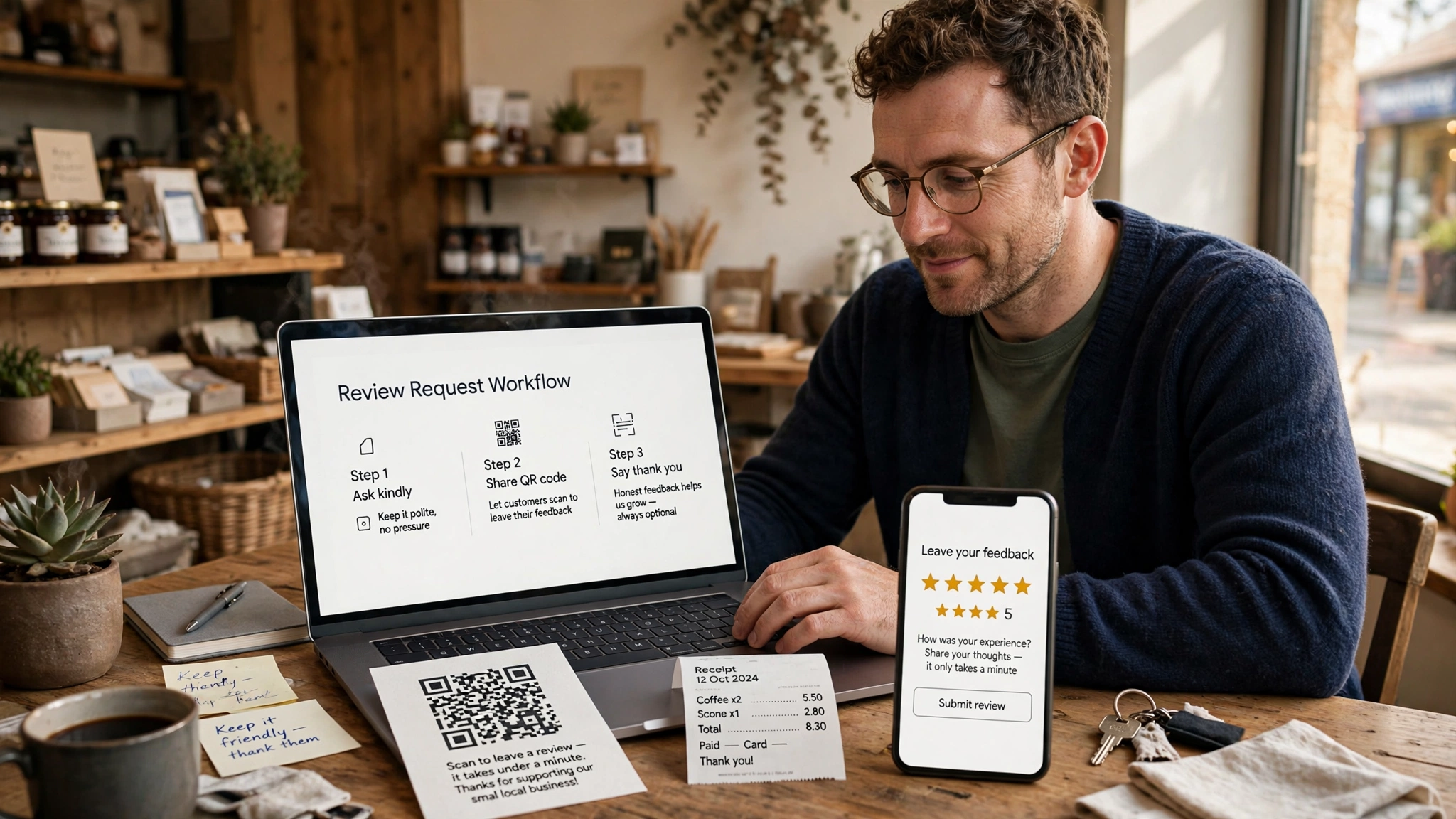
Google provides businesses with a direct review link and a QR-code option. Google specifically suggests using these links or QR codes in places such as receipts and thank-you emails — see the Google review link and QR code guide.
A good request should be:
- Direct: take the customer straight to the review page.
- Short: avoid a long explanation.
- Neutral: ask for honest feedback rather than a positive rating.
- Easy to use: make the process simple on mobile.
- Consistent: use the same basic process for customers.
One polite reminder may be reasonable as part of your own follow-up process, but avoid turning the request into repeated pressure.
Customers need to be signed into a Google Account to leave a review, although that account does not have to use a Gmail address.
QR Codes Are Useful — Pressure Is Not
A QR code can be placed on a receipt, business card, invoice or other customer communication.
The important distinction is between making the review option available and pressuring someone to review you immediately.
Google allows businesses to share a review QR code but prohibits requiring or pressuring customers to leave ratings or reviews while on the premises.
Natural Review-Request Messages
Roofer — Text Message
Hi Mary, thanks for choosing us for the roof repair in Ballincollig. If you have a moment, we’d really value your honest feedback on Google: [link]. Thanks, Seán – O’Connor Roofing
Dentist — Email
Thank you for visiting [Practice name]. We’d be grateful if you’d share your honest experience on Google. It helps other people choose a dentist: [link]
Solicitor — Email After the Matter Closes
Thank you for trusting [Firm name]. If you’d be willing to share honest feedback about our service on Google, you can do so here: [link]. There’s no obligation at all.
Restaurant — Receipt or Card
Enjoyed your meal, or have feedback for us? Tell us honestly on Google: [QR code]
Home Care Provider — Family Communication
Thank you for choosing [Provider name] to support your mother. If you’d like to share your honest experience of our service, you can do so on Google: [link]. We read every piece of feedback.
Words to Avoid
Avoid language that attempts to control the rating or content:
- “If you’re happy, please leave 5 stars.”
- “Please mention Aoife by name.”
- “Leave a review and get 10% off.”
- “Only leave a review if you had a good experience.”
Google prohibits requesting specific review content, selectively soliciting positive reviews and offering incentives in exchange for reviews.
Build a Repeatable Review-Request Process
A simple process is easier for staff to follow consistently.
- Choose the trigger: job completed, invoice sent, treatment finished or matter closed.
- Choose who sends the request.
- Use one approved template.
- Send it at a sensible point after the trigger.
- Use a direct Google review link or QR code.
- Record that the request was sent, where appropriate.
- Review the process regularly.
Do not turn the process into a review quota.
Google specifically prohibits merchants from requesting that staff solicit a certain number of reviews or reviews containing specific content.
The goal is a consistent opportunity for genuine customers to provide feedback — not a target number of five-star ratings.
How to Respond to Positive Reviews
Google encourages businesses to reply to reviews and says helpful replies can demonstrate responsiveness to customers.
For ordinary businesses, a response can acknowledge something specific from the customer’s experience without trying to manufacture additional promotional content.
Restaurant:
Thanks, Ciarán. Delighted you enjoyed the hake. It’s back on the menu every Friday.
Roofer:
Thanks for the kind words. Glad the new gutters held up through last week’s rain.
Regulated Businesses Need Extra Care
Dentists, solicitors, home care providers and other businesses handling sensitive information should avoid confirming private details in public replies.
A safer response can be general:
We’re sorry to read this. We can’t discuss any individual’s care online, but we’d genuinely welcome the chance to talk. Please contact our practice manager, [name], on [number].
The same principle applies to legal matters, care arrangements and other confidential customer information.
How to Respond to Negative or Critical Reviews
A negative review does not automatically mean it should be removed.
Google says businesses can reply to reviews and that honest, balanced reviews can help potential customers make decisions. If a review violates Google’s content policies, businesses can report it for review.
A calm response can follow four steps:
- Acknowledge the feedback.
- Avoid arguing publicly.
- Do not reveal private information.
- Move the conversation offline where appropriate.
Example for a roofer:
Thanks for letting us know, and I’m sorry the clean-up didn’t meet your expectations. That’s not the standard we aim for. I’d like to put it right. Please call me directly on 087 XXX XXXX. Seán, Owner
Example for a regulated business:
We’re sorry to read this. We can’t discuss any individual matter online, but we’d genuinely welcome the chance to talk. Please contact [name] on [number].
Handling Unfair or Inappropriate Reviews Through the Proper Channels
You cannot have a review removed simply because it is negative.
However, Google prohibits various forms of fake or inappropriate review content, including reviews that do not represent a genuine experience, paid or incentivized reviews, reviews created through conflicts of interest, certain personal information and other prohibited content. See Google’s prohibited and restricted content policy.
If you believe a review violates Google’s policy:
- Report it through your Business Profile.
- Select the most accurate policy reason.
- Respond calmly if a public response is appropriate.
- Keep records of the issue.
- Obtain legal advice where a potentially defamatory publication requires further action.
Google may remove violating reviews and can also impose restrictions on Business Profiles involved in fake-engagement activity, including temporarily preventing new reviews or unpublishing existing reviews.
Why You Should Never Buy Reviews
Buying reviews is prohibited by Google.
Google requires reviews to represent genuine experiences and prohibits paid reviews, reviews obtained through incentives and other forms of fake engagement.
Irish consumer-protection rules also matter.
The CCPC says businesses must ensure reviews they display are genuine and take reasonable steps to confirm that they come from real consumers. Businesses must not pay for false or misleading reviews or post fake reviews themselves. See Irish consumer law on fake reviews and unfair practices.
The risks therefore extend beyond having individual reviews removed. Google can impose Business Profile restrictions for fake-engagement violations.
Why Incentivising Reviews Creates Problems
Offering a discount, free service, payment, prize entry or another benefit in exchange for a review is prohibited by Google’s fake-engagement policy. This also applies when the incentive is offered for changing or removing a negative review.
Examples include:
- “Leave a review and get 10% off.”
- “Review us to enter our monthly prize draw.”
- “Leave five stars and receive a free service.”
- “Change your one-star review and we’ll refund you.”
If you want to thank customers, keep the thank-you separate from the review request and do not make the benefit conditional on reviewing.
Review Gating: What It Is and Why to Avoid It
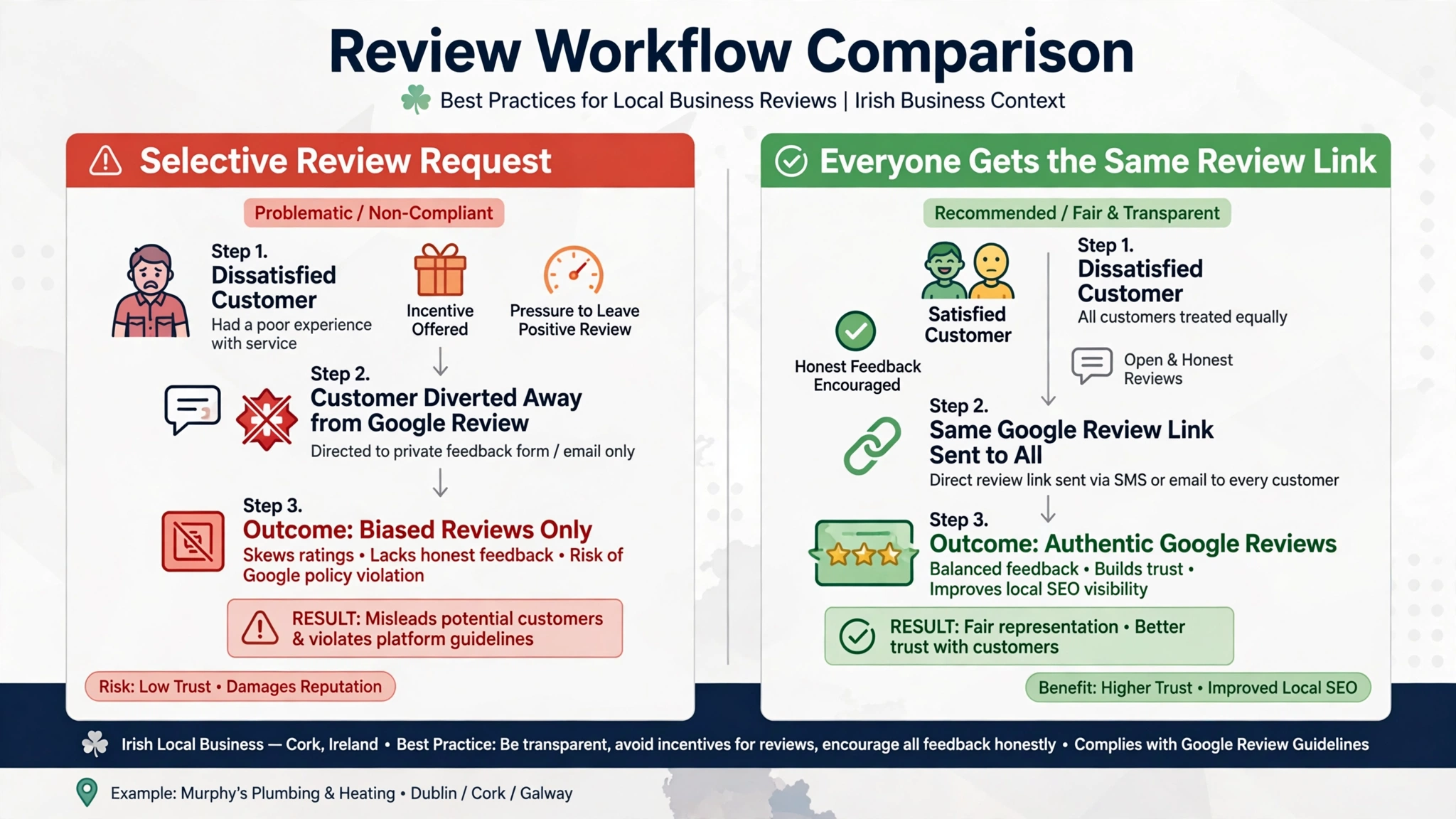
Review gating means filtering customers by satisfaction before asking for a public review.
For example:
- Ask the customer whether they are happy.
- Send happy customers to Google.
- Send unhappy customers to a private feedback form instead.
Google specifically prohibits discouraging or prohibiting negative reviews and selectively soliciting positive reviews.
You can still collect private feedback as part of customer service.
The important distinction is that the private-feedback process should not be used to prevent dissatisfied customers from accessing the same Google review opportunity.
A straightforward approach is:
Everyone receives the Google review link.
Fake and Manipulated Reviews: The Risks
Review manipulation can take several forms:
- Reviews written by the business owner or staff
- Reviews from friends or family where there is a conflict of interest
- Reviews bought from third parties
- Reviews exchanged between businesses
- Multiple accounts used to manipulate ratings
- Fake negative reviews posted about competitors
- Reviews created through incentives
Google’s policy prohibits fake engagement, paid reviews, conflicts of interest and attempts to manipulate ratings.
Irish consumer law also addresses false consumer reviews. The CCPC states that businesses must ensure reviews displayed on their websites are genuine and take reasonable steps to verify that they come from real consumers.
Encourage Honest Feedback, Not Just Positive Feedback
A sustainable review process should ask customers for honest feedback, not a predetermined rating.
Use language such as:
- “We’d appreciate your honest feedback.”
- “Tell us about your experience.”
- “Your feedback helps us improve.”
- “Share your experience on Google.”
Avoid:
- “Please give us five stars.”
- “Only review us if you’re happy.”
- “Mention our team member by name.”
- “Give us five stars and receive a discount.”
Google explicitly allows businesses to encourage genuine reviews without attempting to influence their rating or content.
How Reviews Fit Into Your Wider Local SEO Strategy
Reviews are one part of a broader local SEO system.
They work alongside:
- A complete Google Business Profile
- Accurate business information
- Relevant website content
- Consistent business listings
- Genuine local links
- Useful location pages
- Customer-focused service information
Google says local ranking is primarily based on relevance, distance and prominence, and that reviews form part of the information used in prominence.
For the wider strategy, see our local SEO services.
Using Reviews on Your Website
If you display customer reviews on your own website, make sure they are genuine and presented accurately — see Google’s review structured-data guidance if you use review markup.
The CCPC says businesses displaying reviews must ensure they are genuine and take reasonable steps to confirm they come from real consumers.
Do not selectively edit reviews to change their meaning or present a misleading impression.
How to Monitor Review Growth and Feedback
A simple monthly report can track:
| Measure | What it tells you |
|---|---|
| New reviews this month | Whether the request process is generating new feedback |
| Average rating over time | The overall direction of ratings |
| Response rate | Whether the business is responding consistently |
| Latest review date | How recently customers have provided feedback |
| Common feedback themes | What customers value and what needs improvement |
| Requests sent vs. reviews received | How often customers respond to the request |
Google Business Profile Performance also provides data on searches, views and customer interactions, which can be used alongside review data when assessing local visibility.
Do not judge the review process solely by the number of reviews. The quality of the customer experience behind those reviews matters as well.
When This May Not Apply Directly
- Businesses with very few customers: A low-volume business may naturally receive fewer reviews. Focus on providing every genuine customer with an opportunity to leave feedback rather than chasing an arbitrary target.
- Regulated sectors: Dentists, solicitors, healthcare providers and other regulated businesses need to consider professional confidentiality and advertising requirements when requesting or replying to reviews.
- Businesses serving vulnerable people: Review requests should take account of consent, timing, capacity and the sensitivity of the relationship.
FAQ
Is It Allowed to Ask Customers for Google Reviews?
Yes. Google explicitly allows businesses to ask customers for genuine reviews and provides tools for sharing a direct review link or QR code. However, businesses must not offer incentives, selectively solicit positive reviews, pressure customers on the premises, request specific review content or manipulate ratings.
Can I Offer a Discount for a Google Review?
No. Google prohibits incentives such as free or discounted goods or services in exchange for posting, changing or removing a review.
What Is Review Gating?
Review gating is the practice of directing only satisfied customers toward a public review platform while steering dissatisfied customers toward private feedback.
Google prohibits selectively soliciting positive reviews or discouraging negative reviews.
You can collect private feedback, but do not use it as a filter that prevents dissatisfied customers from leaving a genuine Google review.
Can I Get a Bad Google Review Removed?
Only where the review violates Google’s policies.
Examples include fake reviews, paid or incentivized reviews, conflicts of interest, certain private information, prohibited content and other policy violations. A genuine negative review is not automatically removable simply because the business dislikes it.
If you believe a review violates a policy, report it through your Business Profile using the most accurate reason.
How Many Google Reviews Does a Business Need?
There is no universal number that every business needs.
Review quantity is one of several local-search considerations, while recency and a sustained flow of genuine reviews are also studied by local SEO professionals. Google’s own documentation says more reviews and positive ratings can help local ranking, but it does not publish a fixed review target that guarantees visibility.
Instead of chasing an arbitrary number, create a consistent process that gives every genuine customer an opportunity to provide feedback.
The Takeaway: How to Get More Google Reviews the Compliant Way
If you want to know how to get more Google reviews, start with a simple process rather than a complicated review campaign.
This week:
- Get your direct review link or QR code from your Google Business Profile.
- Write one short, neutral review-request message.
- Send it consistently to genuine customers at an appropriate point in the customer journey.
- Reply to existing reviews without revealing private information.
- Remove incentives, review gating and pressure from the process.
- Monitor review volume, recency, responses and customer feedback over time.
The objective is not to manufacture five-star ratings.
It is to make it easy for genuine customers to share genuine experiences while keeping your review process aligned with Google’s policies and Irish consumer-protection requirements.
If you’d like help building a compliant review process, contact us.