For Irish local businesses, effective link building means earning links and mentions from websites genuinely connected to your location, industry or community.
In other words, link building Ireland is about earning genuine local links rather than buying them.
This link building Ireland guide focuses on practical, low-risk tactics that Irish local businesses can actually use.
That might include:
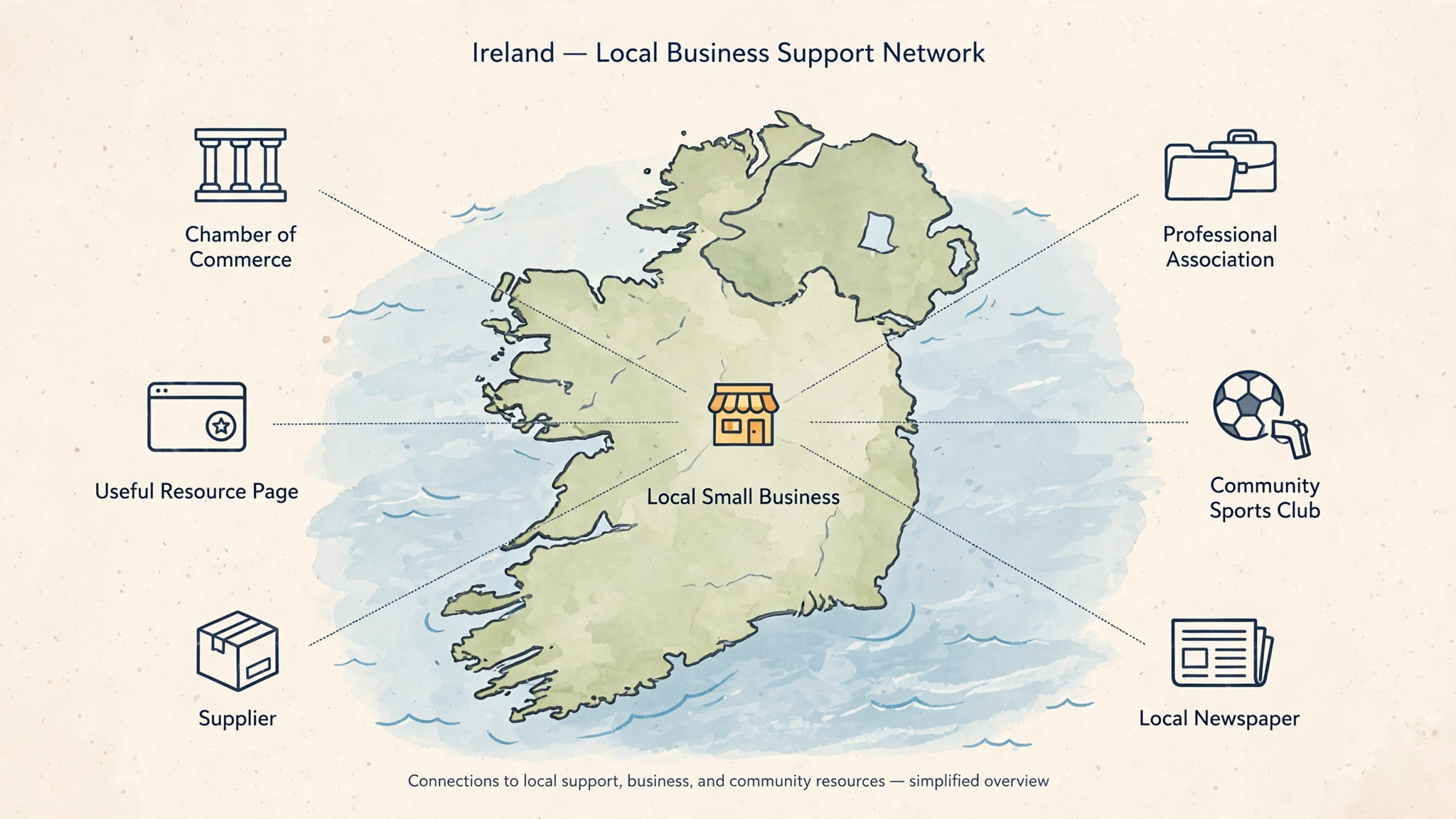
- Your local chamber of commerce
- Trade and professional bodies
- Community groups and clubs you support
- Local newspapers and radio stations
- Suppliers and business partners
- Useful content that other websites want to reference
What usually creates more risk than value? Buying links that pass ranking credit, bulk backlink packages, low-quality directories and link swaps arranged purely for SEO.
A handful of relevant local links can be more useful than hundreds of unrelated ones. There is no fixed number of backlinks that guarantees higher rankings.
At KJK SEO, link building for Irish businesses is about earning genuine local links. Over 4+ years and 150+ projects — including 50+ for Irish businesses — we focus on the kinds of relevant local links that search engines and real customers value.
What’s in This Guide
- What link building means for a local business
- Why relevant backlinks can matter
- Quality links vs low-quality links
- Irish directories and citations
- Local chambers of commerce
- Business and professional associations
- Local clubs and community organisations
- Sponsorship: the honest version
- Local newspapers, radio and publications
- Community events and partnerships
- Guest articles and industry contributions
- Create useful content that naturally attracts links
- How to judge whether a link opportunity is worth it
- Link-building tactics that may violate Google’s spam policies
- Why bulk link packages are a risk
- How to monitor your backlink profile
- Frequently asked questions
How to Read This Guide
- Official Google guidance: What Google’s published documentation says.
- Industry practice: Common SEO approaches and observations that are widely used but are not confirmed by Google as ranking rules.
What Link Building Means for a Local Business
A backlink is a link from another website to yours. Link building is the process of earning or acquiring those links.
For a local business, relevant links often grow from real-world relationships.
A Cork roofer might be mentioned in a local news story. A Dublin accountant might appear in a professional body’s member directory. A Galway café might be listed on a festival’s partner page.
Two related terms are worth understanding:
- Citations: Listings of your business name, address and phone number, often in directories. They may or may not include a link.
- Mentions: Your business is named on another website, with or without a clickable link.
Why Relevant Backlinks Can Matter
Official Google guidance: Google says local search results are influenced by relevance, distance and prominence. Prominence reflects how well-known a business is, and Google says information such as links from other websites can contribute to it. See Google’s tips to improve local ranking.
Industry practice: Local SEO research, including surveys of SEO professionals, has identified locally relevant links as one factor practitioners consider when assessing local visibility. Such surveys reflect expert opinions, not a guaranteed ranking formula.
Links can also provide value beyond search rankings:
- Referral visits from people reading the linking website
- Credibility through association with relevant organisations
- Visibility among local customers and professional communities
- Opportunities for press coverage and business relationships
Quality Links vs Low-Quality Links
| Quality link | Low-quality link |
|---|---|
| Comes from a relevant local or industry website | Comes from an unrelated site with no meaningful audience |
| Exists because of a genuine relationship or useful contribution | Is bought, swapped or automatically generated for ranking purposes |
| Appears in genuine content or a real member listing | Is buried in a footer, sidebar or artificial links page |
| Could realistically be clicked by a customer | Has no plausible audience |
| You would value it even if Google did not exist | Exists only to influence search rankings |
That last point is a useful industry rule of thumb. It also reflects the principle behind Google’s definition of link spam: links created primarily to manipulate search rankings. See Google’s spam policies.
Irish Directories and Citations
Start with accurate listings on platforms and directories that customers or relevant organisations actually use.
Where to Consider Being Listed
- Google Business Profile, Apple Maps through Apple Business Connect, Bing Places and Facebook
- Established Irish directories such as GoldenPages.ie
- Trade and professional bodies’ member directories
- Relevant local tourism, council or business directories
What to Avoid
Official Google guidance: Google identifies low-quality directory or bookmark-site links as an example of link spam.
Industry practice: Keep your business information consistent. Check that your business name, address, Eircode and phone number are accurate across important listings. If you move or change numbers, update the listings you control.
Do not treat every directory submission as a link-building opportunity. Prioritise relevance, accuracy and whether real customers might use the listing.
Local Chambers of Commerce
Most Irish towns and cities have a chamber of commerce. Membership may include a member-directory listing, networking opportunities, event participation and, in some cases, newsletter or website features.
Illustrative example: A Limerick IT support company joins its local chamber. It appears in the member directory, gives a talk at a chamber breakfast about cybersecurity for small firms, and the event is covered in the chamber newsletter and on its website with a link to the company.
The value is not just the backlink. The company also meets potential customers and becomes more visible in its local business community.
Business and Professional Associations
Trade and professional bodies can provide highly relevant links because their audiences are connected to your industry.
Potential opportunities include:
- Trade federations and industry associations
- Professional registers and “find a member” directories
- Accreditation or certification bodies’ approved-member listings
Illustrative example: A Dublin architecture practice joins a professional body. It appears in a “find a practice” directory, and one of its partners contributes an article to the organisation’s member journal.
Check what membership actually includes. Not every register links to member websites; some exist only to verify credentials or registration status.
Local Clubs, Community Organisations and Initiatives
Community involvement can create genuine relationships and opportunities for local recognition.
Consider organisations such as:
- GAA, soccer, rugby and other sports clubs
- Tidy Towns groups
- Local festivals, charity events and fundraisers
- Parish, community and residents’ associations
- Schools, colleges and youth organisations
Illustrative example: A Limerick landscaping company donates plants and a day’s labour to its local Tidy Towns group. The group thanks the business on its website and social media, and a local newspaper covers the project.
The contribution should be worthwhile in its own right. Do not make community support conditional on receiving a followed backlink.
Sponsorship: The Honest Version
Official Google guidance: Google permits paid links used for advertising and sponsorship when they are appropriately qualified with rel="sponsored" or rel="nofollow". Exchanging money, goods or services for links intended to pass ranking credit is listed as link spam. See Google’s guidance on qualifying outbound links.
In practical terms, if you sponsor a club or event and receive a website link, that link should be qualified appropriately. Do not make a followed link that passes ranking credit a condition of the sponsorship.
Why Sponsor, Then?
A sponsorship can provide:
- Visibility among local people
- Goodwill and community relationships
- Referral visits
- Local news coverage, which may include an independent editorial link
- A credible connection between your business and the area it serves
Industry practice: Choose sponsorships you would still be happy to fund if no backlink were included.
Local Newspapers, Radio and Publications
Local media coverage can earn editorial links and introduce your business to people who may not have encountered it otherwise.
Stories that may interest local media include:
- New jobs, expansions or business openings
- Local awards and business milestones
- Useful expert advice connected to a local event
- Human-interest stories with a genuine local angle
Illustrative example: After a named storm, a Cork roofing company offers a short, practical guide for homeowners on safely checking for roof damage. A local newspaper publishes advice from the owner and links to the company website.
Official Google guidance: Paid advertorials or press releases containing links that pass ranking credit can violate Google’s link spam policies, particularly where optimised anchor text is used.
A media pitch should offer a useful story, not simply ask a journalist to publish a keyword-rich backlink.
Community Events and Partnerships
Look at the organisations and businesses you already work with.
- Suppliers and manufacturers: Some publish approved installer, stockist or partner listings.
- Complementary local businesses: Genuine professional relationships may create useful referrals and co-authored resources.
- Local events: Host a useful workshop, information session or community event.
- Colleges and training bodies: Work placements, apprenticeships and guest lectures can build real connections.
Official Google guidance: Google identifies excessive link exchanges and partner pages created exclusively for cross-linking as examples of link spam.
A real partnership can naturally mention both organisations. A network of pages created only to exchange SEO links is different.
Guest Articles and Industry Contributions
Guest contributions can be useful when they are written for a publication your customers or industry actually read.
A worthwhile contribution should:
- Offer practical expertise rather than repackage generic SEO content
- Be relevant to the publication’s audience
- Include a natural author credit where appropriate
- Avoid keyword-stuffed anchor text
Official Google guidance: Google lists optimised anchor text in guest posts or press releases distributed on other sites among examples of link spam.
For example, a byline such as “Mary Byrne is a solicitor at Byrne & Co. in Galway” is natural. A paragraph repeatedly linking phrases such as “best solicitor Galway” is not.
Create Useful Content That Naturally Attracts Links
Content earns attention when it helps people answer a question, make a decision or complete a task.
Ideas for Irish local businesses include:
- Local guides with real expertise: Practical advice that reflects your area and the questions customers ask.
- Original data: For example, an estate agent’s quarterly summary of local sale prices based on its own transactions, with methodology and limitations explained.
- Practical checklists: Clear steps customers can save or share.
- Local resources: Useful directories, explainers or community information that people have a reason to reference.
Official Google guidance: Google warns against creating low-value content primarily to manipulate links or ranking signals.
Publish something useful first. Promotion and links should follow from its relevance, not from manufacturing a reason to link.
How to Judge Whether a Link Opportunity Is Worth It
Before spending money or time, ask:
- Is the website relevant to my location or industry?
- Does it have real readers, members or customers?
- Could a customer realistically click this link?
- Is the link editorial, or am I paying for it?
- Does the website look genuine and maintained?
- Would I still want this link if Google did not exist?
If the only convincing reason for the opportunity is a promise of ranking improvement, investigate carefully.
Link-Building Tactics That May Violate Google’s Spam Policies
Official Google guidance: Google defines link spam as creating links to or from a site primarily to manipulate search rankings. See Google’s spam policies.
Its examples include:
- Buying or selling links for ranking purposes
- Excessive link exchanges or partner pages created exclusively for cross-linking
- Automated programs or services that create links
- Requiring a link in a contract or terms of service without allowing the site owner to qualify it
- Paid articles or advertorials with links that pass ranking credit
- Optimised anchor text in guest posts or distributed press releases
- Low-quality directory or bookmark-site links
- Keyword-rich or hidden links in distributed widgets
- Widely distributed footer or template links
- Forum comments with optimised links
Two situations are worth checking as a small business:
Web designer footer credits: A discreet credit on a site the designer built is different from widely distributing keyword-rich followed links across many client websites.
Supplier contracts: If a supplier requires a link back to its website, or you require one in return, the parties should be able to qualify the link appropriately. Avoid making ranking credit a contractual condition.
Google says sites that violate its spam policies may rank lower or be omitted from search results.
Why Bulk Link Packages Are a Risk
Offers such as “500 backlinks for €99” often rely on the very tactics Google identifies as link spam. They may provide little local relevance and can leave you with a backlink profile that needs investigation or cleanup.
A large backlink count is not proof of authority, trust or business value.
For a more sustainable approach, see our link building service.
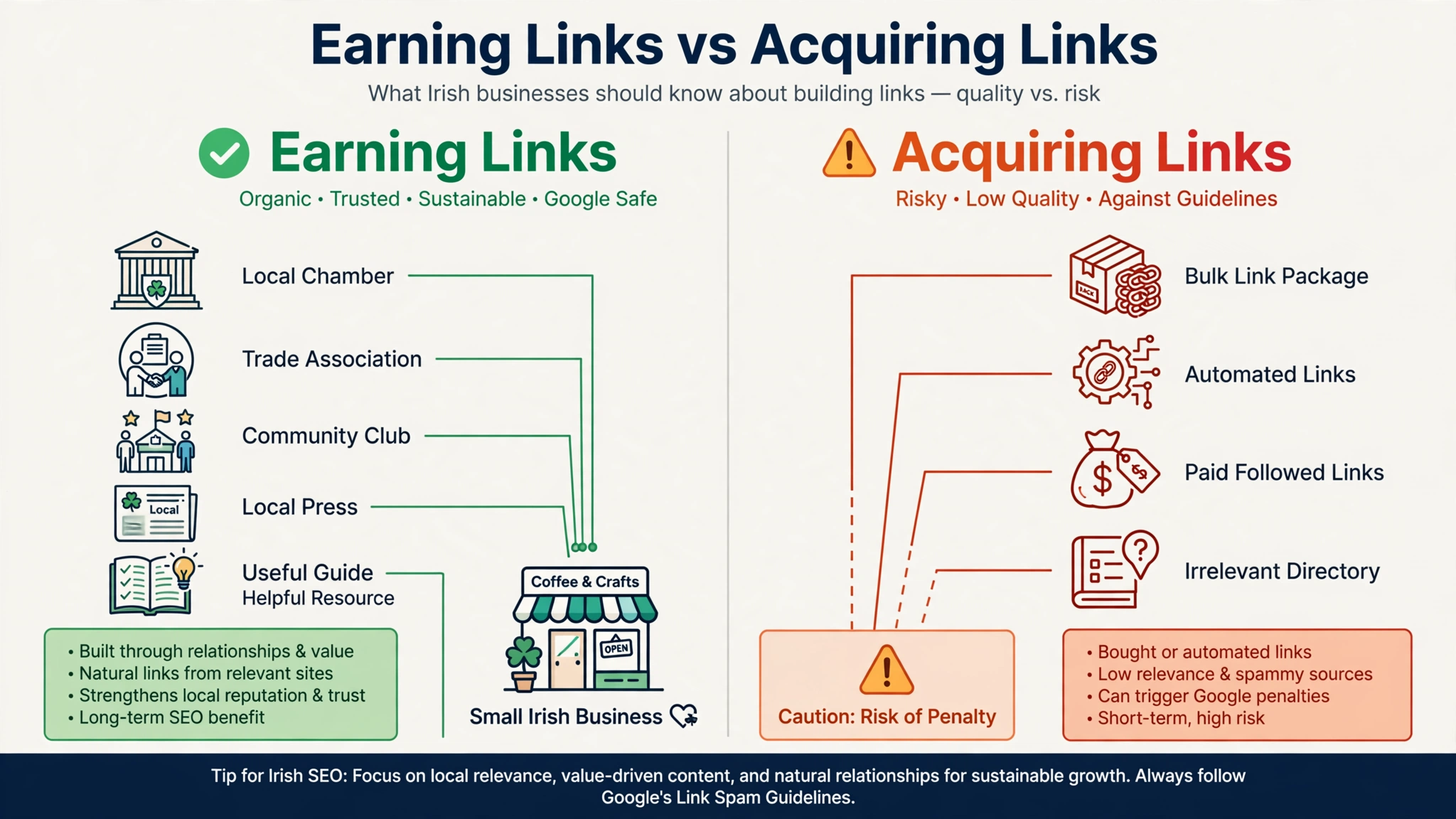
Earning Links vs Acquiring Links
| Earning links | Acquiring links |
|---|---|
| Others choose to link because you are relevant or useful | You pay, swap or automate to obtain links |
| Develops through relationships, content and community | Often relies on purchases or packages |
| Can bring visitors, trust and local relevance | May bring little beyond risk |
| Builds from genuine activity | Can be fragile or breach Google’s policies |
The distinction is about purpose and method, not simply whether money changed hands. Paid advertising and sponsorship can be legitimate when links are qualified correctly.
How to Build Links Without Relying on Bulk Packages
A simple three-month plan gives you a practical starting point.
Month 1: Fix Your Foundations
- Review your core business citations.
- Correct important inconsistencies.
- Join one relevant association or your local chamber if membership offers genuine value.
Month 2: Review Existing Relationships
List your suppliers, partners, clubs, associations and community organisations. Check whether they publish member, partner or approved-provider listings.
Ask about legitimate opportunities to be included. Do not demand a followed link.
Month 3: Publish and Share Something Useful
Create one genuinely helpful resource, then share it with relevant local groups, professional contacts and a journalist where there is a real story angle.
Ongoing
- Take part in one community activity per quarter.
- Pitch local media when you have genuine news or useful expertise.
- Contribute to an industry publication when you have something worthwhile to say.
- Review your links and referral traffic periodically.
For ongoing support, see our managed SEO service.
How to Monitor Your Backlink Profile
You do not need to check backlinks every day. A regular review can help you understand which websites are referring visitors and whether anything unusual needs attention.
Google Search Console
The Links report shows websites linking to you, commonly linked pages and other link information. It is useful for monitoring, but it is not a complete inventory of every backlink.
Third-Party Tools
Tools such as Ahrefs, Semrush and Moz provide their own link indexes and metrics. Their authority scores are third-party estimates, not Google metrics.
What to Look For
- New links from relevant local or industry websites
- Referral visits from websites that link to you
- Sudden spikes in links from unrelated sites that warrant investigation
- Unusual anchor text you did not create
Do not assume that every unfamiliar or spam-looking link requires action.
The Disavow Tool
Google describes the disavow tool as an advanced feature for specific situations, such as a considerable number of spammy or artificial links that have caused, or are likely to cause, a manual action.
It is not a routine backlink-cleaning tool. Review Google’s current disavow links guidance before using it.
Manual Actions
Check the Manual actions report in Search Console for any action relating to unnatural links. Follow the specific guidance shown there rather than disavowing links simply because a third-party tool labels them toxic.
When This Approach May Not Apply
- National or e-commerce businesses: You may need broader industry-level link building and digital PR beyond local relationships.
- Highly competitive city markets: Consistent outreach and sustained digital PR may be needed over a longer period.
- Regulated sectors: Check applicable advertising, professional and sponsorship rules before publishing claims or arranging promotions.
Frequently Asked Questions
How Many Backlinks Does a Local Business Need?
There is no fixed number, and no number guarantees rankings. A few relevant links from a chamber, trade body, local media outlet or community organisation may be more useful than many unrelated links.
Focus on relevance and authenticity. Comparing your link profile with similar local competitors can provide context, but do not turn their backlink count into a target.
Are Irish Business Directories Still Worth It?
Established, relevant directories and trade listings can be useful for accurate business citations and customer discovery.
Google identifies low-quality directory links as a link spam example, so avoid bulk submissions to generic directories. Prioritise Google Business Profile, Apple Maps, Bing Places, established Irish directories and relevant professional or trade listings.
Is Sponsoring a Local Club Good for SEO?
Sponsorship can support local visibility, goodwill and media coverage. Google says paid sponsorship links should be qualified with rel="sponsored" or rel="nofollow".
Do not expect the link itself to pass ranking credit. Choose a sponsorship you would value even without a backlink; community involvement and local awareness are meaningful reasons to participate.
Can I Buy Backlinks in Ireland Safely?
Buying links intended to pass ranking credit breaches Google’s spam policies regardless of location.
Paid placements can be used as advertising when links are qualified with rel="sponsored" or rel="nofollow". Be cautious of packages promising large numbers of backlinks, particularly when the provider cannot explain where the links will appear or why those websites are relevant.
How Long Does Link Building Take to Work?
Timing varies with competition, the websites involved and the quality of the links earned. Genuine local links tend to develop gradually through relationships, content and community activity.
Track referral visits, enquiries and search visibility over several months rather than expecting a quick jump from one link.
The Takeaway
Start with the relationships your business already has.
- List the chambers, associations, suppliers, clubs and community groups you genuinely work with.
- Check which already list or mention your business, and which could do so naturally.
- Correct your core Irish business citations.
- Plan one community activity and one useful piece of content this quarter.
The aim is not to collect the largest possible number of backlinks. It is to build genuine visibility, relationships and useful references that make sense for your business.