Roofing customers often search Google at the exact moment they need help. A leaking roof, storm damage or a failed gutter can turn a normal search into a phone call within minutes.
To get more roofing jobs from Google in Ireland, you need four things:
- A verified Google Business Profile set up correctly as a service-area business if customers do not visit your premises.
- A dedicated website page for each important roofing service, plus genuinely useful pages for your main towns.
- A steady flow of genuine reviews and real project photos.
- A storm-season plan covering both organic SEO and paid search.
Then track every call and enquiry through to the roofing job it became.
The goal is not simply more website traffic. The goal is more qualified roofing enquiries, booked jobs and revenue.
Why SEO Matters for Irish Roofing Companies
Roofing searches generally fall into two broad groups, and they behave differently.
Urgent searches include:
- “emergency roofer Galway”
- “roof leak repair near me”
- “storm damage roof repair”
- “roofer near me”
The homeowner may have water entering the property and wants a business that can respond quickly.
Planned searches include:
- “new roof cost Ireland”
- “flat roof replacement Cork”
- “fascia and soffit replacement”
- “slate roof replacement”
These customers may compare several roofing companies over days or weeks before choosing one.
Trust matters in both situations. A homeowner wants evidence that the company is genuine, experienced and capable of doing the work.
That is why a strong roofing SEO strategy should combine:
- A properly managed Google Business Profile
- Dedicated roofing service pages
- Useful town and location content
- Genuine customer reviews
- Real project photographs
- Relevant local citations
- Industry and local links
- Clear contact information
- Conversion and call tracking
For a broader overview of local search strategy, see our local SEO services.
Step 1: Get Into the Google Map Pack
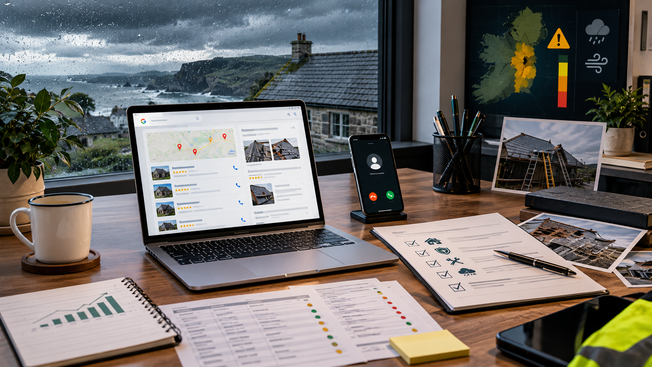
The Google Map Pack is the local results section that displays businesses alongside a map for searches such as “roofer Kilkenny” or “roof repair Cork.”
Google says local results are primarily influenced by relevance, distance and prominence. Complete and accurate business information, reviews and other signals can help Google understand and evaluate a local business.
You cannot control your distance from every searcher, but you can improve the other parts of your local presence.
Set up as a service-area business
Many roofers travel to customers rather than having customers visit their business address.
If you do not serve customers at your business address, Google says you should remove the address from your Business Profile and use service areas instead. You can specify up to 20 service areas, using cities, postal codes or other defined areas. Google also says the overall service area generally should not extend beyond about two hours of driving time from the business base.
You cannot simply draw a radius around your business.
Instead, choose the actual towns or areas where you genuinely provide roofing services.
For example, a roofer based in Mallow might serve:
- Mallow
- Fermoy
- Blarney
- Macroom
- North Cork
That does not mean the business will automatically rank equally throughout those areas. Distance remains an important local-search factor, so businesses generally have an advantage closer to their location.
Do not add every county in Ireland simply because the profile allows multiple service areas. Focus on locations where you actually want work and can provide a reliable service.
Step 2: Optimise Your Google Business Profile for Roofing
Your Google Business Profile is one of the most important assets in a local roofing SEO campaign.
Business name
Use your genuine trading name.
For example:
O’Brien Roofing
Not:
O’Brien Roofing – Emergency Roof Repairs Cork – Best Roofer
Google’s guidelines require businesses to represent themselves using their real-world business name rather than adding unnecessary keywords or promotional information.
Primary category
Choose the most accurate primary category available for the business, such as Roofing contractor where appropriate.
Additional categories should only represent services the company genuinely provides.
The 2026 Whitespark Local Search Ranking Factors survey placed Primary GBP Category first among its expert-estimated local pack ranking factors. This is an industry survey rather than a statement of Google’s internal ranking algorithm, so it should be treated as practitioner evidence rather than an official Google ranking formula.
Services
List the roofing services you genuinely provide.
Examples include:
- Slate roof repair
- Tiled roof repair
- Flat roof repair
- Felt roofing
- EPDM roofing
- Fibreglass or GRP roofing
- Chimney repair
- Lead flashing
- Fascia and soffit replacement
- Gutter repair
- Storm damage repair
- Roof inspections
- Roof surveys
Whitespark’s 2026 survey placed the presence of predefined GBP services at #22 for local pack/Maps ranking factors. Again, this is expert survey data rather than an official Google ranking disclosure.
Hours
Use your actual operating hours.
If you genuinely provide emergency call-outs and have someone available to answer enquiries, make that clear through your business information and website.
Do not claim to be available 24/7 if nobody is answering calls at 2 a.m.
Photos
Upload genuine photographs of your work, team, vehicles, materials and completed projects.
For the broader setup process, see our local SEO services. If you want a dedicated service solution, see our SEO for roofers service.
Step 3: Create a Page for Each Roofing Service
One generic “Our Services” page forces too many different search intents onto one URL.
Instead, create a useful page for every major service that deserves its own search visibility.
Whitespark’s 2026 expert survey ranked Dedicated Page for Each Service #1 for local organic ranking factors.
Pages many Irish roofing companies should consider
- Roof repairs
- Emergency roof repairs
- Flat roofing
- Slate and tile roofing
- New roofs and re-roofing
- Chimney repairs and lead flashing
- Fascias, soffits and gutters
- Storm damage repairs
- Roof inspections and surveys
Do not create pages simply to increase the number of URLs on your website. Each page should answer a real search intent and provide useful information.
What should each service page include?
Include:
- A clear explanation of the service
- Common problems you solve
- Real project photographs
- Areas served
- Factors that influence pricing
- Relevant guarantees, insurance or certifications, where applicable
- Reviews relating to that type of work
- A prominent phone number
- A short quote or enquiry form
- Clear next steps
For example, a new roof page can answer questions about materials, lifespan, preparation, insulation considerations, project timescales and factors that affect cost.
A good service page can attract both traditional search traffic and customers who are researching before contacting a roofer.
Step 4: Build Town and Location Pages
If your roofing company genuinely serves multiple towns, useful location pages can help you establish geographic relevance.
Examples include:
- Roofers in Naas
- Roofing Contractors in Newbridge
- Roof Repairs in Kildare
- Roofers in Mallow
But every location page needs a reason to exist.
A useful town page could include:
- Real roofing projects completed in the area
- Photographs from those projects
- Common roofing issues encountered locally
- Areas or estates you regularly serve
- Honest approximate response or travel times
- A genuine customer review from the area
- Services available in that location
- Local contact information
For example:
Replaced 40 slates and re-bedded ridge tiles on a 1970s semi-detached house in Caragh Road.
That is substantially more useful than changing “Cork” to “Naas” throughout an identical template.
Google’s spam policies specifically describe doorway abuse as creating substantially similar pages targeting cities or regions primarily to manipulate search visibility.
Start with the three or four towns that matter most commercially. Expand only when you have enough genuine local information to make additional pages useful.
Step 5: Target Emergency Roofing Searches
Emergency roofing searches can have extremely high commercial intent because the customer often needs help immediately.
Build a dedicated emergency roof repair page
Put the essentials near the top:
- Emergency phone number
- Areas covered
- Actual emergency hours
- Types of emergency repairs handled
- What customers should do while waiting
- Safety advice
- A clear call-to-action
Make calling effortless
Someone dealing with a leaking roof may not want to complete a long form.
Make the phone number prominent and tappable on mobile.
You can still provide a quote form for customers who prefer written enquiries, but do not hide the phone number below several paragraphs.
Answer the phone
SEO cannot solve a missed call.
If you cannot answer every call during a storm, consider a genuine call-answering or callback process.
Be honest about safety
Roof work during dangerous winds can create serious risks.
Do not encourage homeowners or workers to climb onto roofs during unsafe conditions. Explain that inspections and temporary repairs will be carried out when conditions allow.
Clear, responsible communication builds trust while protecting customers and your team.
Step 6: Use Project Photos to Build Trust
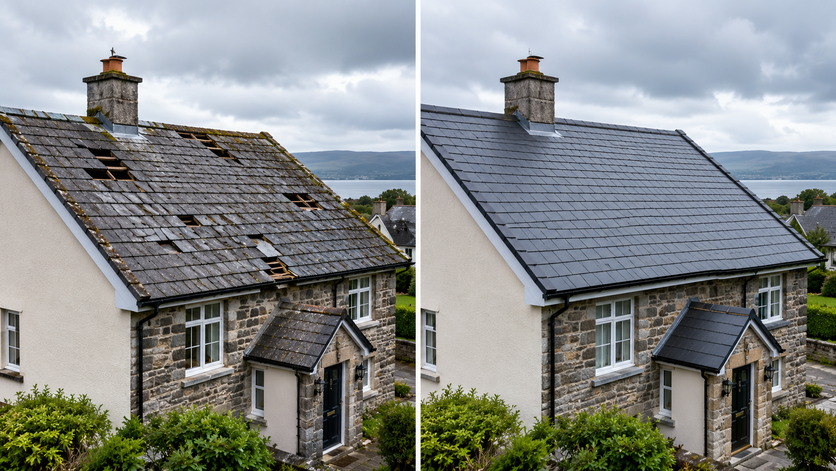
Real project photography is especially valuable for roofing companies because customers want to see evidence of actual work.
Use photographs of:
- Before-and-after roof repairs
- Slate replacement
- Tile replacement
- Flat roof installations
- Chimney work
- Fascia and soffit projects
- Gutter repairs
- Your team working safely
- Your branded vehicles
- Completed properties
Whitespark’s 2026 survey included Photo & Video Quality among its local ranking factors, with the survey specifically distinguishing quality, clarity and non-stock imagery.
Avoid relying on stock photographs
Stock images may look professional, but they do not prove that your company completed the work.
Real photographs create evidence.
Build a project gallery on your website and organise it by service and, where useful, location.
One completed project can potentially support:
- A service page
- A town page
- A case study
- A Google Business Profile photo
- A social media post
- A customer conversation
That makes each project more valuable from a marketing perspective.
Step 7: Get and Manage Genuine Reviews
Reviews are an important trust and local-search signal for roofing companies.
The objective is not simply to collect five-star reviews. It is to build a consistent system for asking real customers for honest feedback.
A simple review process
1. Ask after the job is completed.
Send the customer your Google review link once the work is finished.
2. Ask every customer consistently.
Do not create a system where only customers you expect to be happy are asked.
3. Keep the request neutral.
Ask for an honest review rather than telling the customer what rating or wording to use.
4. Reply professionally.
Thank customers who leave positive reviews. For negative reviews, remain factual and offer an appropriate way to resolve the issue privately.
Google prohibits incentivised reviews, selectively soliciting positive reviews, pressuring customers to leave reviews and asking reviewers to include specific content.
So avoid messages such as:
“Please leave us a five-star review and mention roof repair in Cork.”
A safer approach is simply:
“Thanks for choosing us. If you have a moment, we’d appreciate an honest review of your experience.”
The customer’s review should reflect their genuine experience.
Step 8: List on Irish Directories and Keep Your Details Consistent
A citation is an online mention of business information such as the business name, address and phone number.
For a roofing company, start with the major platforms:
- Google Business Profile
- Apple Maps
- Bing Places
Then consider relevant Irish directories and industry sources.
Whitespark’s current Ireland citation research includes sources such as:
- GoldenPages.ie
- 11890.ie
- IrelandYP
- Yelp
- Hotfrog
Relevant industry directories can also be useful when they genuinely list roofing businesses.
For example, the Construction Industry Federation maintains a searchable members directory with fields including company name, location, county, contact details and website.
The key is relevance and accuracy rather than creating hundreds of low-quality listings.
Use one consistent version of your business information
Create a master record containing:
- Business name
- Address, where applicable
- Eircode
- Phone number
- Website
- Primary category
- Service areas
Use the same information wherever possible.
Step 9: Build Local Relevance and Authority
Links and mentions from relevant websites can strengthen a roofing company’s wider online presence.
Roofers have several natural opportunities to earn relevant mentions.
Suppliers and manufacturers
If you are an approved installer, stockist or recognised contractor, ask whether the supplier maintains an installer directory.
Local organisations
Relevant opportunities may include:
- GAA clubs
- Local charities
- Community organisations
- Schools
- Local events
The objective should be a genuine relationship, not buying random links.
Local media
A roofing business may have useful stories to contribute, such as:
- Storm preparation advice
- Heritage-building restoration
- Local community projects
- Roofing safety information
- Before-and-after restoration work
Professional partners
Builders, architects, property managers and other contractors may have legitimate reasons to mention trusted suppliers or contractors.
Google’s Search Essentials also recommends creating useful, people-first content and making your site discoverable through relevant communities and links.
Step 10: Plan for Storm Season
Irish roofing demand can change rapidly after severe weather.
When major storms affect an area, homeowners may suddenly search for:
- Emergency roof repair
- Storm damage roofer
- Roof leak repair
- Missing roof tiles
- Emergency chimney repair
- Temporary roof repair
Understand Met Éireann warnings
Met Éireann uses Yellow, Orange and Red warning levels to communicate increasing levels of weather impact and risk.
Rather than using warnings to create fear-based marketing, use them as operational triggers.
Storm Éowyn shows the potential scale of extreme weather
Storm Éowyn affected Ireland in January 2025. Met Éireann recorded a provisional maximum gust of 184 km/h at Mace Head, County Galway, alongside other extreme wind records.
That illustrates why roofing companies should prepare their marketing and operations before severe weather arrives.
Before storm season
Ideally, prepare during September and October:
- Check your emergency roofing page
- Check your phone and call-answering system
- Confirm your service areas
- Update relevant Google Business Profile information
- Prepare useful storm-damage content
- Build your Google Ads campaign
- Prepare negative keywords
- Confirm your daily advertising budget
- Make sure someone is available to handle enquiries
During and after a storm
When conditions become unsafe, safety takes priority over marketing.
Once it is safe to operate:
- Update customers about availability
- Explain when inspections can begin
- Keep a callback list if demand exceeds capacity
- Prioritise urgent cases appropriately
- Communicate pricing clearly
- Avoid fear-based claims
A roofing company that communicates responsibly during a crisis can build trust that continues after the storm.
Step 11: Track Calls, Enquiries and Roofing Jobs
Rankings do not pay the wages.
Roofing jobs do.
Your reporting should connect marketing activity to actual commercial outcomes.
1. Track Google Business Profile interactions
Google Business Profile performance reporting can show searches, views, calls, website clicks and direction requests, among other metrics. Google defines the calls metric as clicks on the call button from the Business Profile.
Treat these figures as lead indicators rather than automatically assuming every interaction represents a unique customer or completed job.
2. Track website enquiries
GA4 should record important actions such as:
- Quote form submissions
- Phone-number clicks
- Contact-form submissions
- Other meaningful enquiry events
3. Ask every caller
Use a simple question:
“How did you find us?”
Record the answer.
4. Track job value
A €400 slate repair and a €15,000 re-roof are not equivalent leads.
A useful roofing lead sheet could look like this:
| Date | Source | Job Type | Town | Quoted (€) | Won? | Job Value (€) |
|---|---|---|---|---|---|---|
| XXX | Google Maps | Emergency repair | XXX | XXX | XXX | XXX |
| XXX | Website form | New roof | XXX | XXX | XXX | XXX |
| XXX | Google Ads | Flat roof | XXX | XXX | XXX | XXX |
Review the data monthly.
You should eventually be able to identify which services, towns and marketing channels produce the most valuable roofing jobs.
Step 12: Use Google Ads Alongside Organic SEO
SEO and Google Ads solve different problems.
SEO builds organic visibility over time.
Google Ads can provide paid visibility when you need it immediately.
For roofing companies, the two can work alongside each other.
Always-on campaign
Use a controlled budget around high-value planned services such as:
- New roofs
- Re-roofing
- Flat roof replacement
- Major roof repairs
Storm-ready campaign
Prepare the campaign before storm season.
Keep it paused when appropriate, then activate or adjust it when severe weather creates genuine demand and your business has capacity.
Tight geographic targeting
Target only the towns or areas where you actually provide the service.
Review your Google Ads location settings carefully so your targeting matches your intended customer base.
Call-focused advertising
Use appropriate call assets and make sure advertisements run when somebody can actually answer the phone.
Negative keywords
Build a negative keyword list to reduce irrelevant clicks.
Potential examples include:
- roofing jobs
- roofer salary
- roofing course
- DIY roofing
- how to fix a roof yourself
- roofing apprenticeship
- roofing jobs near me
Review search-term data regularly and add irrelevant searches to your negative keyword list.
What about Local Services Ads in Ireland?
This is no longer a “needs source” item.
Google’s current Local Services Ads documentation for Ireland lists Roofers among the available service categories. Availability and eligibility still depend on Google’s requirements and the business’s location/onboarding status.
That makes Local Services Ads worth evaluating alongside standard Google Ads where the business is eligible.
For broader paid-search support, see our Google Ads management service.
Common SEO Mistakes Roofing Companies Make
| Mistake | Why It Hurts | Better Approach |
|---|---|---|
| Showing an unnecessary home address on Google | Can conflict with service-area business rules | Hide the address when customers are not served there |
| Adding keywords to the business name | Violates Google’s business representation guidelines | Use the genuine trading name |
| One page for every roofing service | Makes it harder to target specific service intent | Build useful dedicated service pages |
| Copy-paste town pages | Can create doorway-style pages | Add genuine local information and completed projects |
| Stock photos everywhere | Provides little evidence of real work | Use genuine project photographs |
| Missed calls during storms | High-intent enquiries can be lost | Use a reliable answering or callback system |
| Claiming 24/7 availability without coverage | Creates inaccurate expectations | Publish genuine hours |
| Buying or manipulating reviews | Violates review policies | Request honest reviews from genuine customers |
| Creating hundreds of weak citations | Quantity alone does not create relevance | Prioritise accurate, relevant sources |
| Measuring only traffic | Traffic does not equal revenue | Track enquiries, won jobs and job value |
When This SEO Strategy May Not Apply
Local SEO can be highly relevant to residential roofing companies, but it is not the only route to business.
Commercial and industrial roofing
Large commercial roofing companies may rely heavily on:
- Tender opportunities
- Contractor relationships
- Procurement platforms
- Property managers
- Construction partnerships
- Industry reputation
Local search can still contribute, but it may not be the primary acquisition channel.
Very large service areas
If a company genuinely serves a large portion of Ireland, one Google Business Profile cannot simply dominate every local search.
The website, organic content, relevant authority and paid campaigns may need to carry more of the geographic demand.
Severe weather periods
During a Red warning or dangerous conditions, safety and operational capacity come first.
Marketing should never encourage unsafe roof access or unnecessary emergency work.
FAQ
How long does SEO take for roofers in Ireland?
It depends on competition, location, website quality, Business Profile condition, existing authority and the amount of work required.
Business Profile corrections and technical improvements can produce earlier changes, while service pages, reviews, local authority and organic visibility generally require ongoing work.
A competitive Dublin roofing market is different from a smaller rural market, so there is no reliable universal timeframe.
How do roofers get into the Google Map Pack?
Start with a properly configured and verified Google Business Profile, the most accurate primary category, relevant services, genuine reviews, real photographs and accurate business information.
Then build useful service and location pages and strengthen the business’s local relevance.
Google says local ranking is influenced by relevance, distance and prominence, so no single optimisation guarantees a Map Pack position.
Should roofers use Google Ads or SEO?
For many roofing businesses, the two can complement each other.
SEO can build long-term organic visibility, while Google Ads can provide paid visibility when demand is immediate.
Storm-ready advertising can be particularly useful when the business has the capacity to respond to increased demand.
Do storms increase roofing demand in Ireland?
Severe storms can create sudden demand for roof inspections, temporary repairs and storm-damage work.
The exact increase will vary by storm, location and severity, so roofing businesses should measure their own calls and enquiries rather than assuming a fixed percentage increase.
How many service areas can a roofer add on Google?
Google currently allows up to 20 service areas, based on cities, postal codes or other areas served. Google also says the overall service area should generally remain within about two hours of driving time from the business base.
Choose areas you genuinely serve rather than adding locations solely for ranking purposes.
Can roofers use Local Services Ads in Ireland?
Yes. Google’s current Ireland documentation lists Roofers as an eligible Local Services Ads category, subject to Google’s location and onboarding requirements.
The Takeaway
If you are an Irish roofing company and want more work from Google, start with the fundamentals.
- Set up your Google Business Profile correctly as a service-area business where appropriate.
- List your genuine roofing services and choose the most accurate primary category.
- Create dedicated service pages for the work you actually want to sell.
- Build useful town pages based on genuine local experience rather than copied templates.
- Ask every genuine customer for an honest review.
- Publish real project photographs that demonstrate your work.
- Prepare an emergency roofing page before storm season.
- Build your paid campaigns before severe weather arrives.
- Track calls, enquiries, won jobs and job value.
The real objective of SEO for roofers Ireland is not to collect rankings or traffic screenshots.
It is to turn relevant Google searches into qualified enquiries, booked roofing work and measurable revenue.