How To rank on Google Maps in Ireland, you need four things:
- A verified Google Business Profile with the most accurate primary category
- A steady flow of genuine Google reviews
- Identical business details, including your Eircode, across Irish directories
- A website whose pages back up the services and towns you want to be found for
Google weighs three things when it ranks local results: relevance, distance and prominence. You can’t move your premises, but you can strengthen the other two. This guide walks through each step in the order that tends to move rankings fastest.
How Google decides who appears in the Google Map Pack in Ireland
The “map pack” is the block of three business listings with a map that appears above the normal results for searches like “electrician Galway” or “dentist near me.”
Google’s explanation of how it chooses those three is short:
- Relevance: how closely your profile matches what the person searched for.
- Distance: how far you are from the searcher. If they haven’t shared their location, Google estimates it.
- Prominence: how well known you are, judged partly by links to your business and your review count and ratings.
Google doesn’t publish the detailed weightings. The best public proxy is Whitespark’s 2026 Local Search Ranking Factors survey, in which 47 local search experts scored 187 factors. Here are its top five map pack factors, in order:
- Your primary GBP category
- How close you are to the searcher
- Keywords in your business name
- Having a physical address in the city being searched
- Whether your business is open at the time of the search
Treat this as informed opinion, not a leaked algorithm. The survey itself says none of the contributors have special access to how Google’s local algorithm works. It is also mostly North American, with only a handful of European contributors. The broad priorities hold up in Ireland, but test before you trust any single factor.
Step 1: Claim, verify and complete your Google Business Profile
Start at business.google.com. Claim your profile, or create it if none exists, and complete verification. Google says a verified profile is more likely to appear in search results. Then fill in every field that applies to you.
Business name. Use your real trading name, exactly as it appears on your signage and invoices. Google’s guidelines say adding extra information to your business name isn’t allowed and can get your profile suspended.
Yes, keywords in the business name rank highly in the survey. That’s exactly why competitors stuff them in. Don’t copy them.
If a competitor calls themselves “Best Plumber Cork Emergency 24/7,” suggest an edit on their profile or report it. Removing spam listings is ranked #19 in the survey, so it’s a legitimate tactic in its own right.
Address or service area. Many Irish trades run from home: roofers in Kerry, electricians in Meath, mobile hairdressers in Limerick. If that’s you, hide your address and set a service area instead.
Google allows one profile for the central office, with a designated service area. A service business can’t use a virtual office unless it’s staffed during your listed hours. Keep the service area realistic. Setting service areas larger than two hours’ drive appears on Whitespark’s list of negative and suspension-risk factors.
Map pin and Eircode. This matters more in Ireland than most guides admit. Many rural addresses share a townland name. If your pin sits on the wrong building or in the middle of a field, Google measures distance from the wrong spot. Correct map pin placement ranks #10 in the survey.
Open your profile on Google Maps, zoom in, and drag the pin onto your actual premises. Use your Eircode in the address wherever the form allows it.
Hours. Set your real opening hours, including bank holidays. Whitespark notes that businesses can drop in the rankings as closing time approaches and get displaced by competitors who are open. It also warns against listing hours you don’t keep, which frustrates customers and breaks Google’s guidelines.
Services. Add Google’s predefined services for your category first, then custom ones. Presence of predefined services was a new factor in 2026 and went straight in at #22.
Photos. Upload real photos of your premises, team, van and finished work. Skip stock images.
Description and Posts. Write your description for customers, not for Google. Keywords in the GBP description rank #171 out of 187, and frequency of Google Posts ranks #148.
Posts can still help convert someone who is already looking at your profile. Use them for offers and news, but don’t expect them to lift your ranking.
Step 2: Choose the right business categories
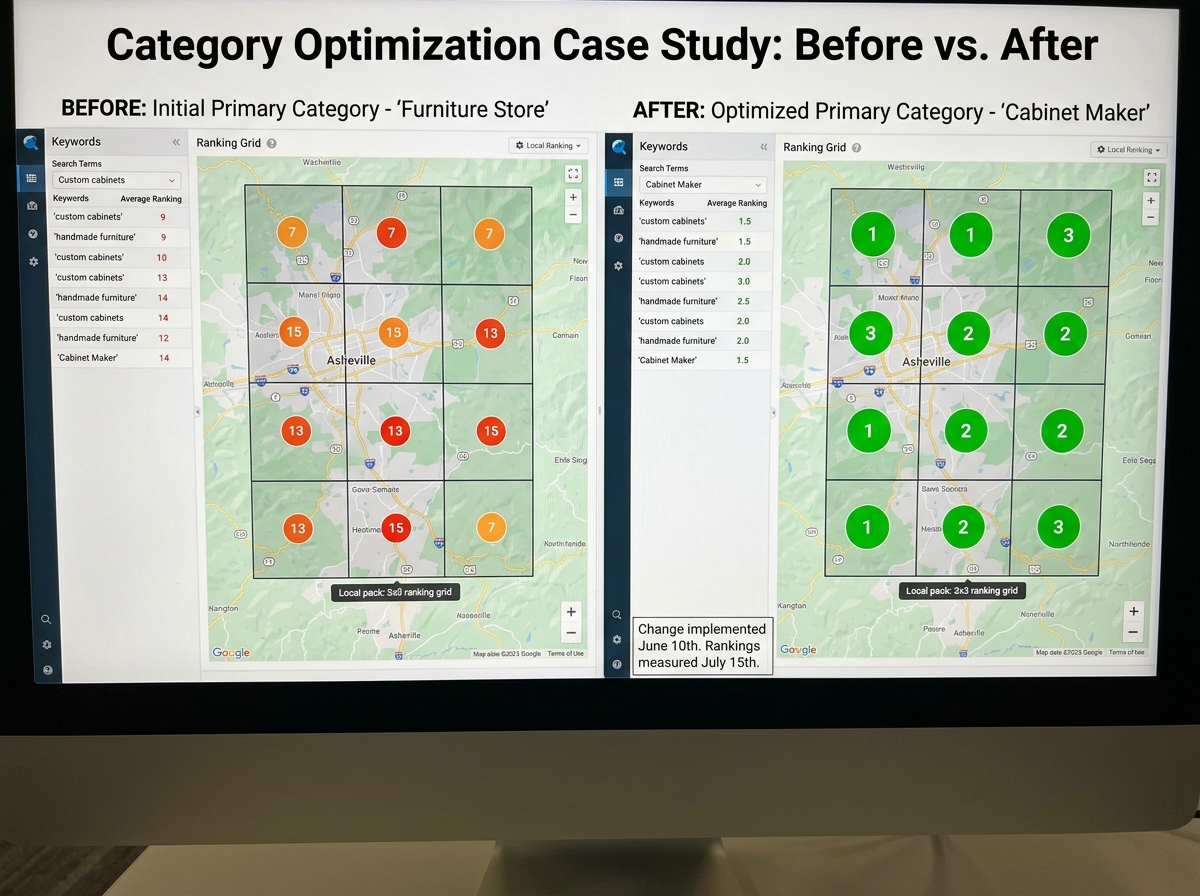
Your primary category is the most important field on your profile. Google’s guidance is to pick a primary category that describes your business as a whole and to be specific, for example “Nail salon” rather than “Salon.”
For additional categories, Google tells you to use as few as possible and not to add a category for every product or service. Individual jobs belong in the Services section, not in categories.
To find the right primary category:
- Search your main service in your town, such as “physiotherapist Waterford.”
- Note the primary category of the top three results. A free Chrome extension such as GMB Everywhere or PlePer will show it.
- Choose the most specific category that honestly describes your core business.
Irish profiles use UK and Irish English category names. Google’s en-GB help page, for instance, uses “Grocery shop” and “Chemist” in its examples. Search the category list rather than assuming the American term exists.
Change categories deliberately, not as a weekly experiment. Editing a category can trigger a request to verify your business again.
Step 3: Build a steady flow of genuine reviews
Reviews feed prominence directly. Google states that more reviews and positive ratings can help your local ranking. The survey puts:
- High Google ratings at #6
- Number of Google reviews with text at #9
- Review recency at #11
- A steady influx of reviews over time, rather than bursts, at #14
A trickle every week beats 40 reviews in one month followed by silence.
What’s no longer allowed. Google’s policy prohibits:
- Discouraging negative reviews or asking only happy customers (“review gating”)
- Pressuring people to review while they’re still on your premises
- Asking for specific content, including staff names
- Telling staff to collect a set number of reviews
- Incentivised or biased reviews
Several of these clauses were added on April 17, 2026. So the counter-top tablet and the “ten reviews a month” staff target both need to go.
A system that stays compliant:
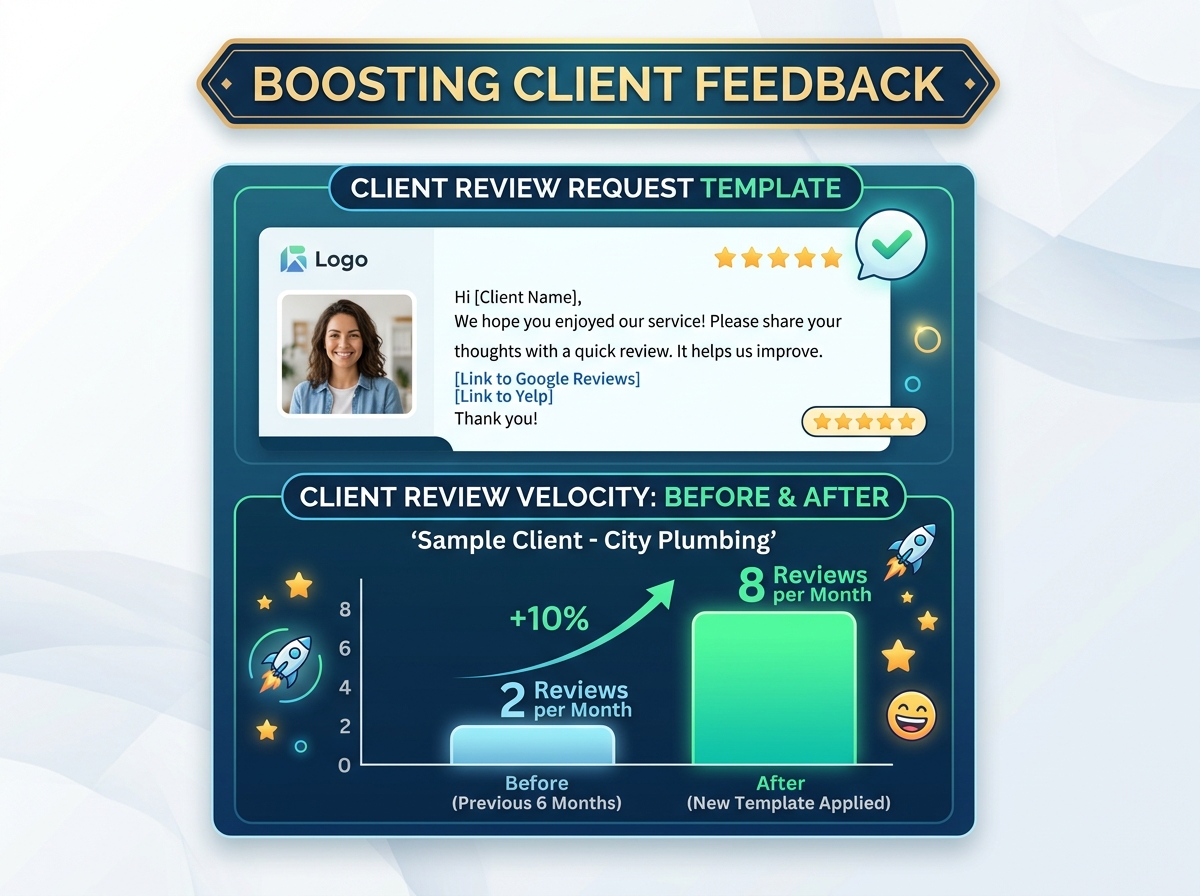
- Send every customer the same review request by text or email within a day of the job. Use your GBP short review link.
- Keep the message plain: “Would you mind sharing your experience on Google?” Don’t hint at star ratings or content.
- Reply to every review, good or bad, within a few days. Google recommends replying because it shows you value customer feedback.
- Don’t stuff keywords into your replies. Keywords in owner responses rank #182 of 187. Write like a person.
Step 4: Make your Irish citations consistent
A citation is any online listing of your business name, address and phone number, known as NAP. The point isn’t volume. The point is that every listing says the same thing.
Before you touch any directory, write down your master NAP: exact trading name, address format, Eircode and phone number. Copy and paste it everywhere. “St.” on one site, “Street” on another and a missing Eircode on a third creates unnecessary doubt.
Priorities in order:
- Google, Apple Maps and Bing Places. Consistency on the main map platforms ranks #28 in the survey.
- Core Irish directories. Whitespark’s list of top citation sources for Ireland includes Apple Maps, GoldenPages.ie, IrelandYP, 11890.ie, Facebook, Foursquare, Yelp and Hotfrog. Some smaller sites on such lists close or change, so check each one is still live before you spend time on it.
- Industry and local bodies. Examples include your professional association, your local Chamber of Commerce and trade federations. These carry real relevance for your sector.
Citations are also becoming more important for AI search. Three of the top five AI search visibility factors in the survey are citation factors.
Step 5: Build location pages that deserve to rank
Your website is the evidence behind your profile. Several on-page factors rank highly in the survey:
- Your website’s NAP matching your GBP (#15)
- Keywords in the title tag of the page your profile links to (#17)
- Local geographic relevance of your content (#18)
- A dedicated page for each service (#24)
For local organic results, a dedicated page per service is the #1 factor.
A location page earns its place when it contains things only you could write:
- Jobs you’ve actually done in that area, with photos
- The team who covers it
- Local landmarks or estates you serve
- Honest travel times
- Questions local customers actually ask
A page for “Dublin” that is your “Cork” page with the town name swapped isn’t a location page. Google’s spam policies call that a doorway page.
For examples of what substantive city pages look like, see our SEO services in Cork and SEO services in Dublin pages.
Add LocalBusiness structured data. Google’s documentation says this markup can tell Google about your opening hours, departments and more, and that each location should be defined as its own LocalBusiness. The ranking weight is modest, but it removes ambiguity. A minimal Irish example:
{
“@context”: “https://schema.org”,
“@type”: “Plumber”,
“name”: “Your Trading Name”,
“telephone”: “+353 21 000 0000”,
“url”: “https://example.ie/cork/”,
“address”: {
“@type”: “PostalAddress”,
“streetAddress”: “Unit 4, Example Business Park”,
“addressLocality”: “Cork”,
“addressRegion”: “Co. Cork”,
“postalCode”: “T12 XXXX”,
“addressCountry”: “IE”
}
}
Test it with Google’s Rich Results Test before publishing. Make sure every detail matches your profile.
Step 6: Earn local prominence beyond Google
Google says prominence is partly based on how many websites link to your business. Links from locally relevant websites rank in the mid-20s of the survey. In Ireland, the natural sources are close to home:
- Sponsoring a GAA or soccer club
- Local newspaper coverage of a project or hire
- Your chamber of commerce
- Suppliers’ “find an installer” pages
- Community events you genuinely take part in
None of this is fast, and none of it can be bought in bulk safely. It is also the part competitors find hardest to copy.
For a wider view of how this fits into local SEO in Ireland, see our local SEO services.
How to track your Google Maps ranking in Ireland properly
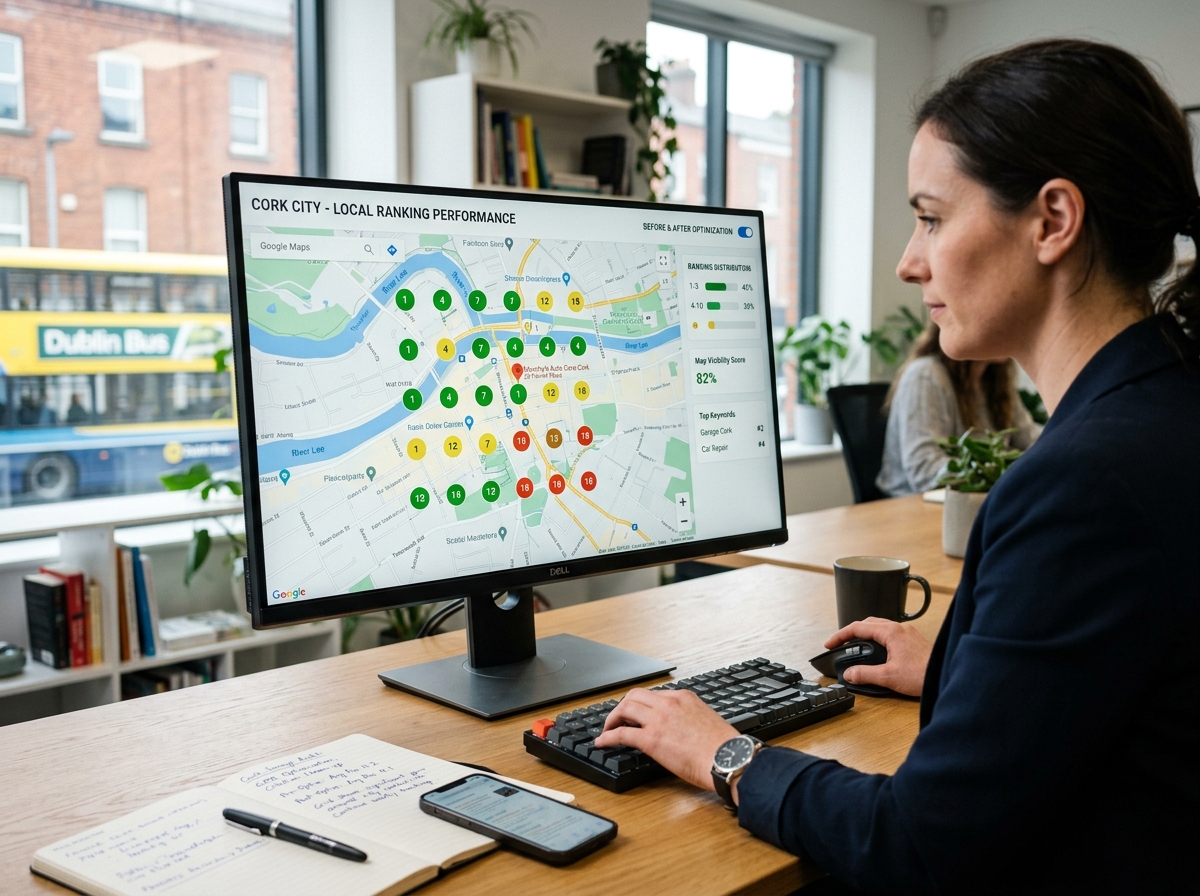
Checking “plumber Galway” on your own phone tells you almost nothing. Results change with the searcher’s exact location. You might be first outside your door and invisible two kilometres away.
Use a grid-based rank tracker instead. Whitespark Local Ranking Grids, Local Falcon and BrightLocal all run the same search from points spread across a map. Take a baseline scan before you change anything, then rescan monthly.
Pair that with the Performance section in your Business Profile, which shows calls, direction requests and website clicks. Most importantly, count actual enquiries. A ranking that doesn’t produce calls isn’t worth chasing.
Common mistakes that hold Irish businesses back
Most map pack SEO problems start with shortcuts that break Google’s rules or waste time on low-impact tasks.
| Mistake | Why it hurts | Fix |
| Keywords added to the business name | Suspension risk | Use your real trading name. Report competitors who don’t. |
| Virtual office or co-working address | Breaches guidelines | Use a staffed premises or become a service-area business |
| Two profiles for one business | Splits your signals | Merge or remove the duplicate |
| Fake 24/7 hours | Breaches guidelines, annoys customers | List real hours |
| Review kiosk or staff review targets | Banned since April 2026 | Send one consistent request to every customer |
| Copy-paste town pages | Doorway page risk | Write pages with real local proof |
| Relying on weekly Posts | Low ranking weight | Put the time into reviews and service pages |
When this may not apply
- Distance has limits. If your premises are 25 km outside a city, you’re unlikely to hold a city-centre map pack for “near me” searches, however well you optimise. Focus on the area around your verified location.
- Paid results can crowd you out. Whitespark notes that where Local Services Ads appear, they sit above the map pack and take a big share of clicks.
- Suspensions are a different job. If your profile is already suspended, fix the underlying guideline breach and follow Google’s reinstatement process before any of the steps above.
FAQ
How long does it take to rank on Google Maps in Ireland? It depends on your competition and your starting point. Fixing a wrong primary category or a misplaced pin can show effects quickly. Building reviews and local links takes months. Measure with a grid tracker so you see real movement, not guesses.
Can I rank on Google Maps without a shop or office? Yes. Service-area businesses such as tradespeople and mobile services can hide their home address and set a service area instead. You’ll usually rank strongest near the address you verified at, so keep your service area realistic. A few counties you actually cover works better than all 26.
Do Google Posts help my Maps ranking? Only slightly, based on the evidence available. The 2026 Whitespark survey places post frequency near the bottom of 187 factors. Posts are still worth using for offers, events and news, because they can persuade someone already viewing your profile. Just don’t treat them as a ranking tactic.
Is a Google Business Profile enough to get into the map pack? In a quiet niche in a small town, sometimes. In competitive places like Dublin or Cork, rarely. Your profile sets relevance, but reviews, consistent citations, locally relevant links and strong service or location pages build the prominence that separates the top three from everyone else.
Can I pay Google to rank higher on Google Maps? No. Google states there is no way to request or pay for a better local ranking. You can pay for ads that appear alongside or above local results, but they are clearly labelled and are separate from the organic map pack.
The takeaway: where to start this week
Don’t try to do everything at once. Work in three stages:
- This week: fix the things that cost nothing. Check your primary category, hours, map pin, predefined services and business name.
- This month: set up a review request that goes to every customer, and audit your NAP across Google, Apple, Bing and the main Irish directories.
- This quarter: build one genuinely useful page for each service and each area you serve, and start earning local links.
If you only do one thing today, open your Business Profile and check your primary category against the top three businesses for your main search. It is the highest-weighted factor you control, and it takes two minutes to check.