
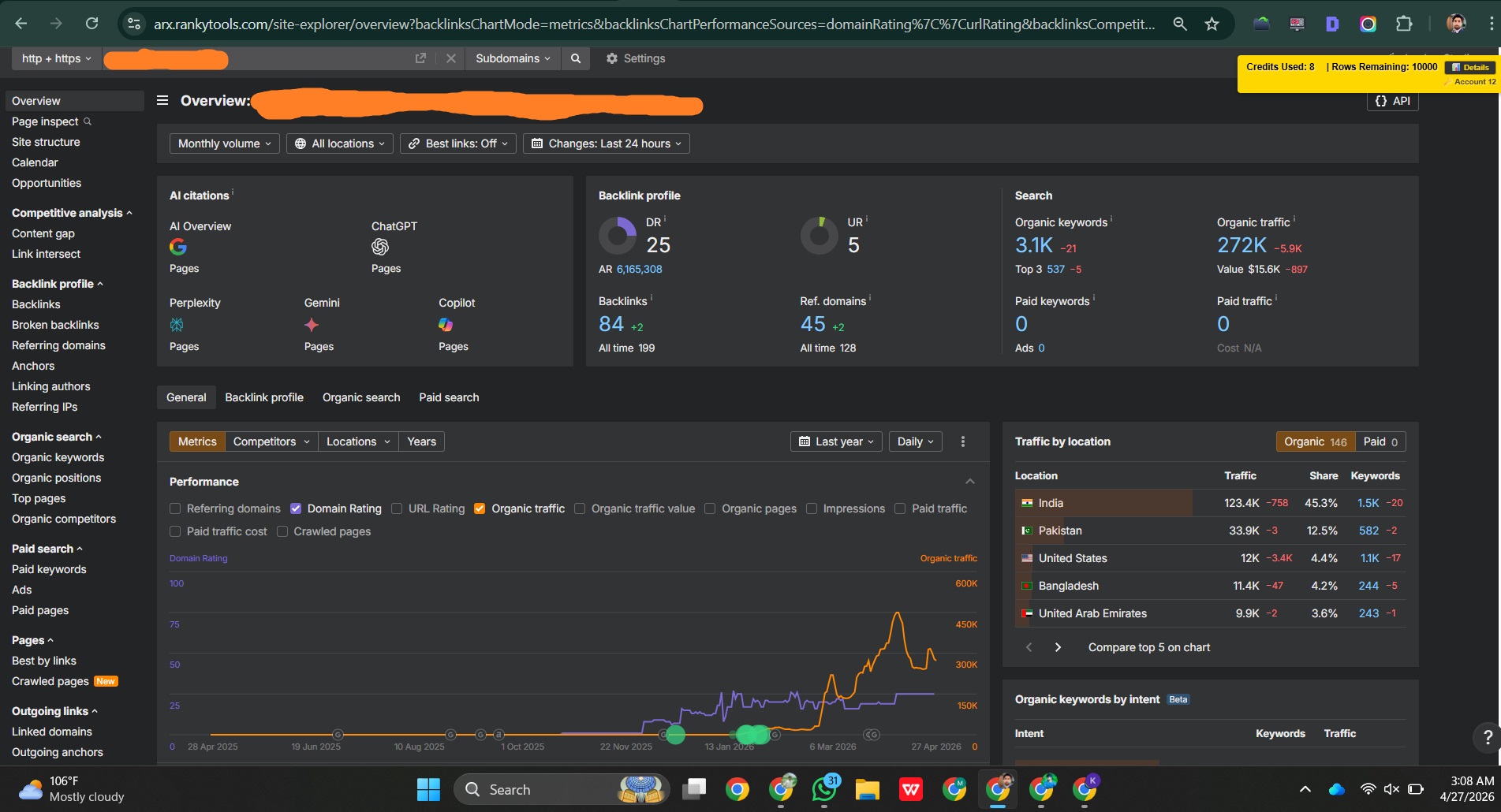
A Domain Rating of 25 and 84 total backlinks doesn’t sound like the foundation for 272,000 monthly organic traffic. That’s exactly the point.
This Blog Website SEO Case Study documents how a content-driven website with a genuinely modest backlink profile built 3,100 ranking organic keywords, 537 of them sitting in the top three positions, and an estimated organic traffic value of $15,600 a month — proof that authority-building done with precision beats authority-building done with volume.
The Growth Behind the Numbers
The growth chart tells the real story behind the numbers.
From the site’s earliest tracked data through roughly November 2025, both Domain Rating and organic traffic sat almost completely flat — a long, quiet runway with nothing dramatic happening.
Then, starting around December 2025 and accelerating hard through January and April 2026, the chart breaks upward sharply, with organic traffic climbing from a flat baseline into the hundreds of thousands and Domain Rating following a steep, parallel climb.
That’s not a lucky viral moment. That’s the visible signature of sustained content and link-building work compounding past a critical threshold.
Why Most Content Sites Never Break Past a Flat Baseline
The vast majority of content and tool-adjacent websites plateau exactly where this domain started — low Domain Rating, a thin backlink profile, and a small number of ranking keywords that never expands.
That plateau isn’t usually a content quality problem. It’s almost always a structural one:
- Not enough topical coverage to build genuine keyword breadth
- Insufficient referring domain diversity to build trust
- No deliberate strategy to turn isolated rankings into a compounding content cluster
This domain broke that pattern specifically because the keyword and traffic growth wasn’t built one article at a time in isolation — it was built as an interconnected content structure designed to expand organic keyword coverage systematically.
That’s exactly why the keyword count and traffic line moved together rather than traffic spiking without keyword breadth to support it.
The Strategy: Topical Depth, Backlink Quality, and AI-Ready Structure
This Blog Website SEO Case Study rests on three deliberate pillars.
1. Topical Content Expansion
First, topical content expansion — building out the keyword footprint methodically rather than chasing isolated high-volume terms.
This is how the site reached:
- 3,100 total ranking keywords
- 537 top-three keyword positions
According to Ahrefs’ own explanation of how Domain Rating is calculated, DR reflects the strength of a site’s backlink profile relative to others in their index — meaning the climb from a flat baseline to DR 25 reflects real, accumulated referring-domain trust, not a metric quirk.
2. Referring Domain Quality Over Raw Volume
Second, referring domain growth over raw backlink volume.
45 referring domains behind 84 total backlinks is a healthy, diversified ratio, signaling links earned from genuinely distinct sources rather than a handful of domains linking repeatedly.
3. AI-Ready Content Structure
Third, and increasingly critical: structuring content to be citation-ready for AI engines.
This domain is now being cited across:
- Google AI Overview
- ChatGPT
- Claude
- Perplexity
- Gemini
- Microsoft Copilot
Five independent AI systems pulling from the same content base — which only happens when pages are written with the clarity and extractability these engines require.
What the Traffic-by-Location Data Confirms
Organic traffic spread across India, Pakistan, the United States, Bangladesh, and the United Arab Emirates shows this isn’t a single-market ranking win — it’s broad-based organic visibility across multiple countries simultaneously.
That’s significantly harder to achieve than dominating one geography and strongly reinforces that the underlying content and authority signals are working globally, not just locally.
What This Case Study Proves
This Blog Website SEO Case Study proves that explosive-looking growth charts aren’t usually explosive at all underneath — they’re the visible tail end of a long, disciplined runway of content and authority building that finally crosses a threshold.
272K organic traffic and citations across five AI engines didn’t happen by accident; it happened because every layer — content depth, backlink quality, and AI-readiness — was built to compound together.
See more SEO and AEO/GEO case studies proving this same principle across different site types.
FAQ: Building Organic Authority for Content and Tool Websites
Can a website with a low Domain Rating still rank for thousands of keywords?
Yes. As shown here, a DR of 25 supported 3,100 ranking keywords and 537 top-three positions when backed by methodical topical coverage and a diversified, quality-focused backlink profile.
Why did this site’s growth look flat for so long before breaking out?
Content and authority signals typically need time to accumulate before search engines fully trust a domain. The flat period represents that trust-building phase; the breakout reflects the threshold being crossed.
How does a site get cited across multiple AI engines at once?
By structuring content clearly enough — factual, well-organized, and directly answering specific questions — that independent AI systems like ChatGPT, Gemini, Copilot, and Perplexity can each extract and cite it reliably.