
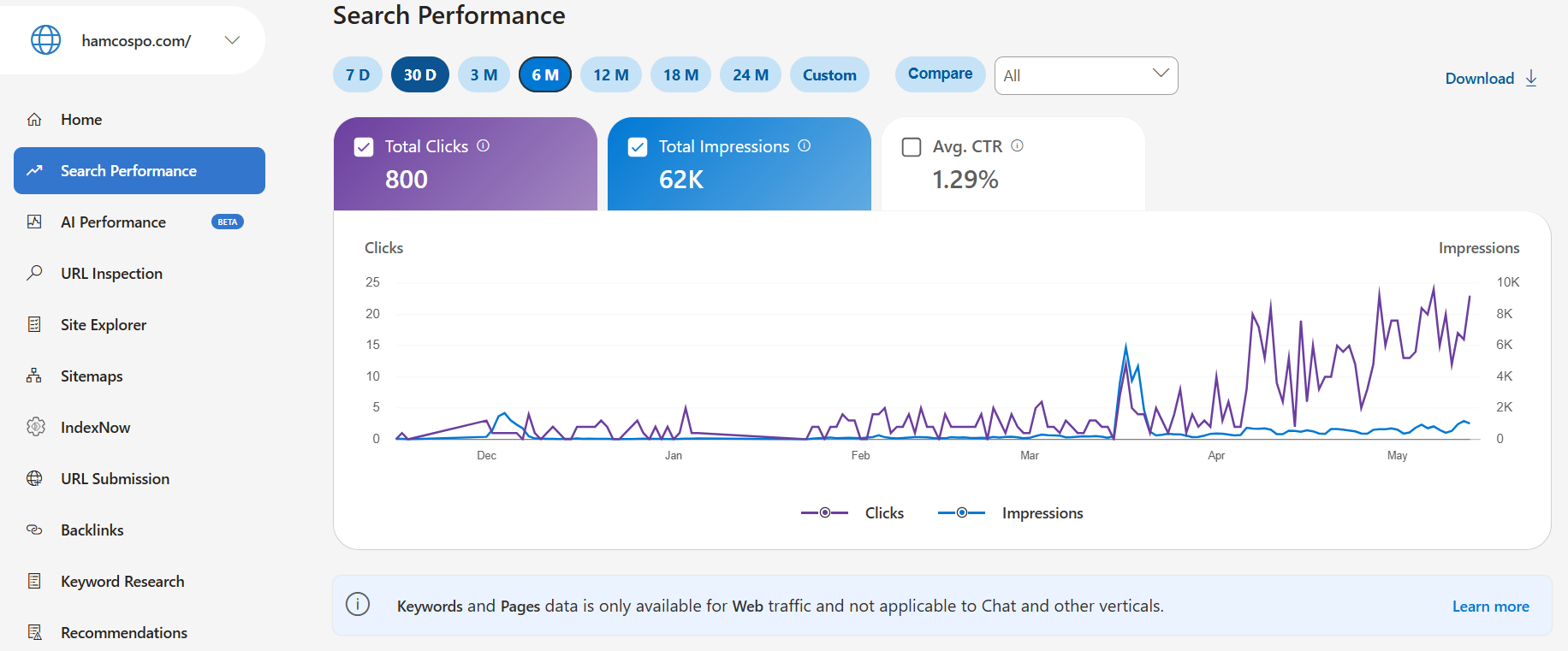
This Bing SEO case study covers Hamco Sports, the same custom sports uniforms eCommerce brand documented in prior Google Search Console results, but tracked through Bing Webmaster Tools over a six-month window. Total clicks reached 800 and total impressions reached 62,000, with an average click-through rate of 1.29% across the full period.
What makes this data set particularly useful isn’t the raw numbers, it’s the shape of the growth curve, and how closely it mirrors the pattern already seen on Google for the same domain over the same general timeframe.
The Flat Period and the Breakout Point
From December through early April, both clicks and impressions on Bing sat in a flat, low band — clicks rarely exceeding 5, impressions barely registering above zero on the chart scale.
Then, in early-to-mid April, the pattern shifted decisively: clicks jumped into a 15-25 range and impressions climbed into a 4,000-10,000 band, sustained through May rather than spiking once and falling back.
This Bing SEO case study is a useful cross-check on a common SEO assumption: that ranking gains on one search engine don’t necessarily transfer to others. Here, the same domain-wide technical and content work that improved Google visibility produced a near-identical flat-then-breakout curve on Bing, in roughly the same calendar window.
That’s a strong signal the underlying fixes were structural — crawlability, content quality, site architecture — rather than something narrowly tuned to one engine’s specific ranking factors.
Why Bing Performance Often Gets Ignored
Most SEO strategy and reporting focuses almost exclusively on Google, since it holds the largest share of search volume in most markets. But Bing still represents meaningful, often-overlooked traffic — and critically, Bing’s index also powers Microsoft Copilot’s web-grounded answers, meaning Bing visibility has a direct downstream effect on AI citation potential as well.
According to Microsoft’s own Bing Webmaster Tools documentation, the same technical SEO fundamentals that drive Google visibility directly inform how Bing crawls, indexes, and ranks a site.
For Hamco Sports, this meant the technical SEO foundation, content restructuring, and authority-building work done as part of the broader engagement wasn’t a Google-only investment — it compounded across both major search engines simultaneously, at no additional strategic cost.
What This Cross-Engine Pattern Proves
A single search engine showing growth could be coincidence, an algorithm update, or a temporary fluctuation. The same growth pattern appearing independently on a second major search engine, on the same domain, in the same window, is much stronger evidence that the work itself — not platform-specific luck — drove the result.
That’s the core value of this Bing SEO case study: it corroborates rather than duplicates the existing Google data.
See more SEO and eCommerce case studies.
FAQ: Bing SEO and Cross-Engine Visibility
Does ranking well on Google guarantee good Bing rankings too?
Not automatically, but both engines reward similar technical and content fundamentals. Sites with strong crawlability, structured content, and authority signals tend to see correlated growth across both, as shown in this case study.
Why does Bing visibility matter beyond Bing’s own search share?
Bing’s index also powers Microsoft Copilot’s web-grounded responses, so improving Bing visibility can directly support AI citation visibility in Copilot as well.
How long does it typically take to see Bing ranking improvements?
In this case, the data showed a flat baseline for several months before a clear breakout, suggesting Bing’s indexing and trust-building timeline can run in parallel with Google’s rather than lagging significantly behind.