
This multi-platform AI SEO case study is the second half of the hamcospo.com turnaround story. The first phase covered the classic Google Search Console results, 223K impressions, 1.72K clicks, and an average position jump from 22.2 to 9.1. This phase tracks a different surface entirely: how often hamcospo.com, a custom sports uniforms eCommerce brand, started getting cited directly inside AI-generated answers, across every major AI engine, over that same four-month engagement.
Platform-by-Platform Citation Breakdown
The platform-by-platform citation and indexed-page movement is below:
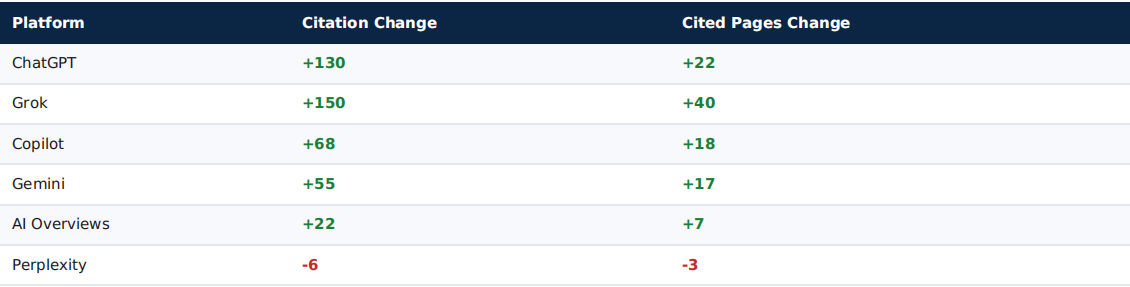
Five of six tracked platforms moved decisively in the same direction, with Grok and ChatGPT showing the largest absolute gains in both citation count and distinct pages cited.
That consistency across independently-trained AI systems — Google’s own AI Overviews, OpenAI’s ChatGPT, Google’s Gemini, Microsoft’s Copilot, and xAI’s Grok — is the strongest signal in this dataset, because it shows the gains came from genuine content and structural improvements rather than one platform’s algorithm quirk.
Why Perplexity Moved Differently
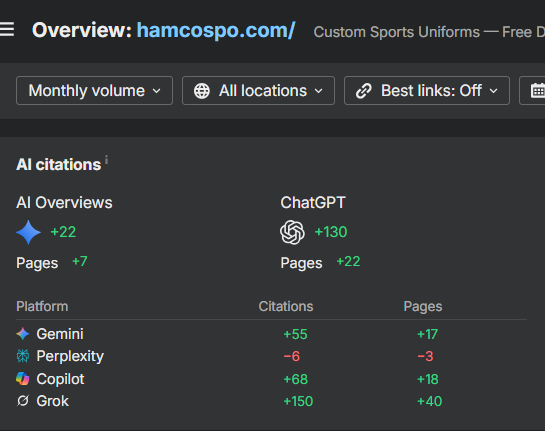
Not every platform in a multi-platform AI SEO case study moves in lockstep, and Perplexity’s slight pullback (-6 citations, -3 pages) is worth addressing directly rather than burying it.
Perplexity sources differently than the other engines tracked here — it leans more heavily on its own real-time crawling and ranking layer, weighting freshness and its own citation database rather than relying on the same underlying search index signals that feed Copilot, Gemini, and AI Overviews.
A small, single-digit dip on one platform while five others show strong sustained growth is a normal variance pattern in cross-platform AI visibility, not a sign of a failed strategy — it simply reflects that each engine has its own crawling cadence and citation criteria.
What Drove the Citation Growth
The citation gains across ChatGPT, Gemini, Copilot, Grok, and AI Overviews trace directly back to the same technical and content rebuild covered in the companion B2B eCommerce SEO case study on this same domain: clean technical crawlability, entity-clear structured data, and content rewritten into extractable, answer-formatted sections rather than generic product copy.
That overlap is the real point of this multi-platform AI SEO case study: classic SEO and AI/GEO visibility aren’t separate disciplines requiring separate strategies. The same crawlability fixes, schema markup, and intent-matched content that moved hamcospo.com from 9 keywords to page-one average positioning in Google also made the site legible enough for ChatGPT, Gemini, Copilot, and Grok to start citing it directly.
For background on how generative engines select and weight sources, see Microsoft’s documentation on Copilot’s underlying search and citation behavior.
What This Means for B2B eCommerce Brands Tracking AI Visibility
A custom sports uniforms brand getting cited 130 additional times on ChatGPT and 150 additional times on Grok in four months represents real, measurable presence inside the research layer buyers increasingly use before they ever visit a website.
For a B2B eCommerce brand competing in a niche market, that citation presence compounds the same way organic rankings do — each citation is a chance to be the recommended source rather than invisible to it.
Read the full picture of this engagement in the companion B2B eCommerce SEO case study, or browse all SEO case studies for results across Local SEO, AEO/GEO, and technical SEO engagements.
FAQ: Multi-Platform AI Citation Tracking
Why do different AI platforms show different citation results for the same site?
Each platform — ChatGPT, Gemini, Copilot, Grok, AI Overviews, and Perplexity — uses its own crawling, indexing, and source-selection criteria. A site can gain strongly on most platforms while showing minor variance on one, as seen with Perplexity in this case study.
Does improving traditional SEO also improve AI citation visibility?
Yes. The technical crawlability, structured data, and intent-matched content that improve Google rankings are the same fundamentals AI engines rely on to identify and cite trustworthy sources.
How is AI citation growth measured?
Citation tracking tools monitor how often a domain is referenced inside AI-generated answers and how many distinct pages from that domain are pulled into those answers, broken down by platform.