Some case studies show steady, respectable growth. This one shows a graph that goes nearly vertical.
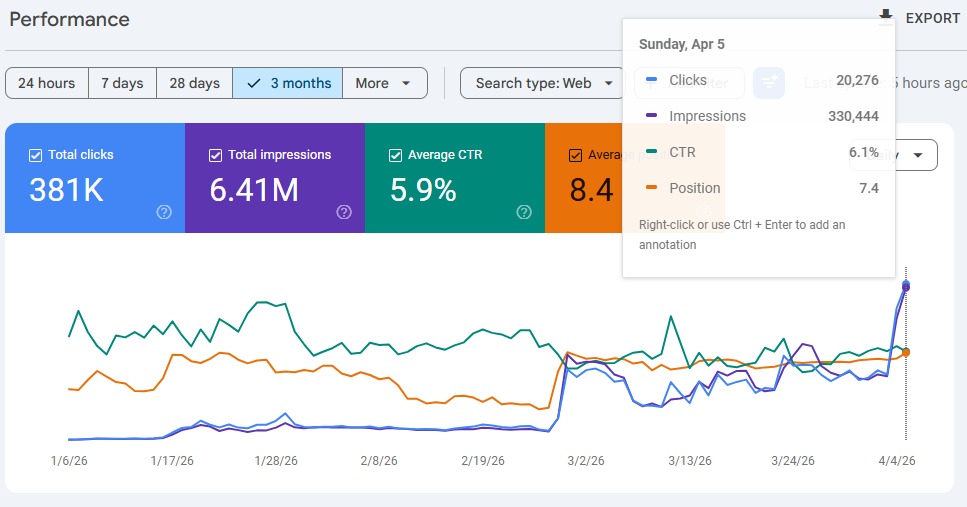
This Tool website SEO case study documents a free online utility website that generated 381,000 total clicks and 6.41 million impressions in just four months, with one single day, April 5th, producing 20,276 clicks and 330,444 impressions on its own, straight from Google Search Console data.
An average position of 8.4 across that window means this wasn’t a handful of lucky long-tail rankings carrying the numbers. It means broad, sustained page-one visibility across a meaningful keyword set, with a 5.9% average click-through rate proving the rankings were converting into real clicks, not just impressions sitting unclicked on page one.
Why This Growth Curve Looks Different From a Normal SEO Win
For the first several weeks of the tracked period, every metric — clicks, impressions, CTR, position — moved in a tight, unremarkable band.
Then, in late February, the entire chart broke at once: CTR jumped, position tightened, and clicks and impressions both launched off their flat baseline simultaneously.
That’s not what a single ranking improvement looks like. That’s what it looks like when multiple growth engines — technical SEO, AEO/GEO content structuring, and backlink authority — all reach critical mass in the same window and compound together.
The Three-Layer Strategy Behind the Spike
This Tool website SEO case study isn’t a one-trick result. Three distinct strategies were run in parallel, and the spike is what happens when all three land at once.
Full-spectrum technical and on-page SEO
Full-spectrum technical and on-page SEO came first — site speed, crawlability, internal linking, and on-page content rebuilt around the exact terms users actually search when looking for this type of free tool, not generic descriptions of what the tool does.
AEO and GEO content structuring
AEO and GEO content structuring ran alongside it — restructuring key pages into clear, directly answerable, extractable formats so both classic answer engines and generative AI tools could pull the site’s content into direct responses, rather than the content sitting in paragraph form that no algorithm could cleanly lift.
Backlink authority and velocity
Backlinks did the heaviest lifting of all. A free tool website lives or dies on authority signals, because utility tools get linked to constantly across blogs, forums, and resource pages when they’re genuinely useful — and that linkability was deliberately activated through targeted outreach and authority-building campaigns.
Backlink velocity is one of the strongest trust signals search engines use to decide how aggressively to rank a domain, and the timing of the backlink push lines up directly with the late-February breakout on the chart.
Reading the April 5th Spike
A single day generating 20,276 clicks and 330,444 impressions isn’t random noise — it’s what a domain looks like once it has crossed a trust and authority threshold high enough that a single piece of content, a single viral mention, or a single algorithm favor gets massively amplified instead of capped.
That kind of spike doesn’t happen to a domain still building baseline trust. It happens to a domain that’s already been engineered to be ready for it.
What This Case Study Proves
This Tool website SEO case study proves that AEO, GEO, and backlink authority aren’t separate, optional add-ons to SEO — they’re the compounding engine behind results that look impossible until you’ve seen the strategy behind them.
381,000 clicks and a 20K-click single day in four months isn’t luck. It’s what happens when every layer of modern SEO gets executed at once, on a site built to capitalize the moment it breaks through.
See more SEO and AEO/GEO case studies proving this approach works across niches.
FAQ: AEO, GEO, and Backlinks for Tool Websites
Why do free tool websites benefit so heavily from backlinks?
Free tools naturally attract organic links from blogs, forums, and resource pages because they’re genuinely useful — but that linkability has to be activated through deliberate outreach, not left to chance.
What’s the difference between AEO and GEO for a tool website?
AEO structures content to be selected as a direct answer in search and voice results. GEO structures content specifically to be cited and referenced inside AI-generated responses from tools like ChatGPT and Gemini.
Is a traffic spike like this sustainable?
A spike reflects a domain that has crossed a trust threshold; sustaining it requires continued content, backlink, and technical investment rather than a one-time push.